11.4.13

Salle Pleyel


There are different concert halls in Paris, but Salle Pleyel is perhaps, together with the smaller and older Salle Gaveau,,the only ones really built as such.

Pleyel and Gaveau were both French piano makers, as was Erard. Erard was the oldest one, starting production in 1777. Haydn owned number 28 (manufactured in 1800), Beethoven number 133 (manufactured in 1803). In 1960 Erard merged with Gaveau which had started production in 1847. Their pianos were 1971-94 manufactured by Schimmel in Germany. Finally Pleyel took over Erard, Gaveau, and Rameau.

Pleyel started production in 1807; family members were excellent musicians and composers and their pianos reached a great reputation and were Chopin’s, Ravel’s, de Falla’s and Stravinsky’s favourites. Already in 1885 Pleyel manufactured some 2500 pianos a year. Today the French piano production is all handled by a company called La Manufacture Française des Pianos and they produce only a very limited number of high value Pleyel pianos.

Pleyel and its then manager decided to build the concert hall Salle Pleyel, which stood ready in 1927, with some 3000 seats.  However, the 1929 crisis led to bankruptcy and a bank took over the concert hall in 1933 and owned it until 1998, when La Manufacture Française des Pianos took over as well the piano production as the concert hall. After an important renovation 2002-06, the concert hall belongs since 2009 to the Cité de la Musique, a group of institutions dedicated to music, most of them situated in the Paris La Villette area (see previous post). A new larger symphony concert hall is there under construction. This may lead to a different future concert program at Salle Pleyel.

But since 1927 and still today, Salle Pleyel is a reference for the highest international level of especially classical music performers, orchestras, soloists… It’s the home of the Orchestre de Paris the Orchestre Philhamonique de Radio France. However, also some world leading jazz musicians and modern bands, groups and singers have performed here.

After the latest renovation with further improved acoustics, the number of – now comfortable – seats has been reduced to some 1900.

The design is very much 1920/1930, exterior and interior, and is very simple – the music is supposed to play the major role.


I had the chance to visit the place while the Orchestre de Paris had a pause in a rehearsal. It gives you a chance to stand on the scene,


It’s surprising to see the little – and simple – space available behind the scene.


This is the door through which the artists enter.


Below the large concert hall there are some smaller ones, which occasionally are used for solo performances or chamber music, but mostly seem to serve as rehearsal space.


Despite the name of the place, I found more Steinway than Pleyel pianos around.


On a second floor you can find a bar / café / restaurant, of course open in connection with concerts, but also as an everyday lunch restaurant.  


8.4.13

Under the cupola...


Not easy to get in here, but there are some exceptions...

We all know the “Institut de France” from outside. Approaching it on the Pont des Arts, we admire the cupola and we know that it’s the place where all the French “académies” have their official meetings.
I already posted about this building in a post about the “Bibliothèque Mazarine” (Mazarin library), in the eastern wing, and told the story about how it was originally created as a “Colllège des Quatre Nations” and opened in 1682 – bequest by Cardinal Mazarin at his death in 1661. This fantastic building (architect Le Vaux) was thus a school building – for privileged pupils - until the Revolution. In 1805 Napoleon decided to make it the place for the French “académies”. (Previously they were housed at the Louvre – actually they had disappeared during the revolutionary years but were reestablished.)

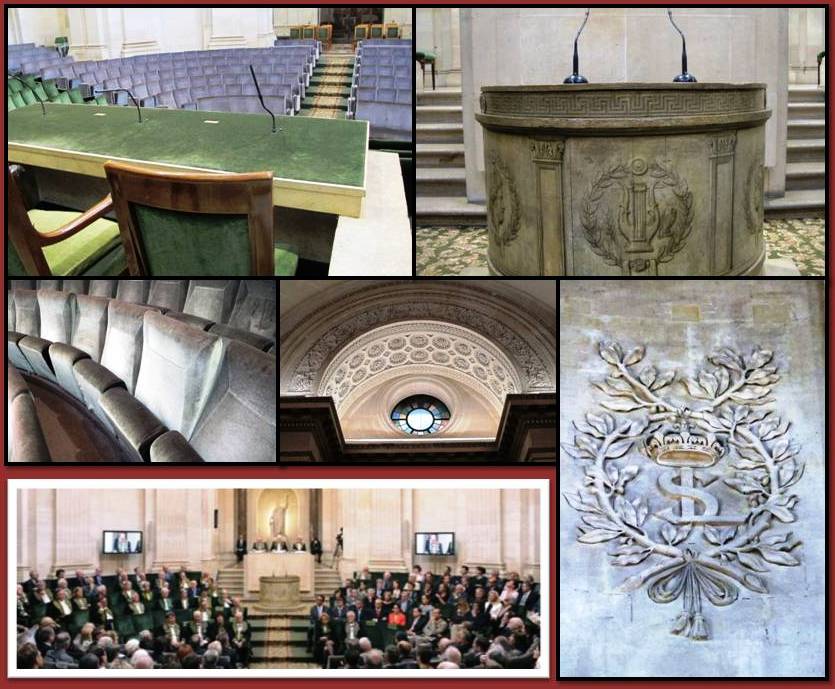
Originally, the space under the cupola was made as a chapel, where Mazarin’s tomb should be placed. When the academies* were installed, the space was transformed - and has been again, now with seats (in green for the academy members, in grey for invited people).


The round cupola that we see from the outside is less round seen from the inside. Through the inner windows we can see that there are other windows behind.


Mazarin’s tomb is now in the entrance hall. The beautiful monument (by Coysevox and others)  is however empty of its contents – the Revolution passed. Actually there is another little cupola also over this space. … and of course we can again find Napoleon.


On a photo from around 1900 we can see that a statue was placed in front of the building. For some reason, it has later been moved to a place nearby. The monument in question from 1848 is the first official representation of the French Republic.  

______________________________
*/
- Académie Française (French Academy, concerning French language), founded in 1635
-Académie des Inscriptions et Belles-lettres (Academy of Humanities), founded in 1663
-Académie des Sciences (Academy of Sciences), founded in 1666
-Académie des Beaux-arts (Academy of Fine Arts), created in 1816 after merger of previous art and music academies
-Académie des Sciences Morales et Politiques, (Academy of Moral and Political Sciences), founded in 1795, suppressed in 1803 and reestablished in 1832


4.4.13

Hôtel de la Païva


I had the opportunity to visit the Hôtel (town house, mansion) de la Païva on the Champs Elysées, constructed by a famous courtesan, Esther Lachmann, later Pauline Thérèse Lachmann, later Madame Villoing, later Mme la Marquise de Païva, later Countess Henckel von Donnersmarck, but always referred to as “La Païva”.

Born in Moscow in 1819 in miserable conditions, she fled her first early marriage and arrived in the slums of Paris, became mistress of a famous pianist, met influent people, married in 1851 to a Portuguese marquis and got her name (her first husband had died in the meantime). The day following the Portuguese marriage she is said to have stated "You wanted to sleep with me, and you have done so, by making me your wife. You have given me your name, I acquitted myself last night. I have behaved like an honest woman. I wanted a position, and I've got it, but all you have is a prostitute for a wife. You can't take me anywhere, and you can't introduce me to anyone. We must therefore separate. You go back to Portugal. I shall stay here with your name, and remain a whore.“  ... and he left, but they officially divorced only 20 years later, when she got married to an enormously rich Prussian count, Guido Henckel von Donnersmarck, eleven years her junior. He offered her a castle, the famous Donnersmarck diamonds and, already before the marriage, allowed her to build this mansion, considered to be the most elegant in Paris.

She was much loved by her last husband, who worshipped her all his life, although he remarried after Païva's death in 1884 - at the age of 64. They had then left Paris, forced by the difficult French / Prussian relations in the 1870's and settled down in the husband's Prussian castle (today in Poland). Finally, she could enjoy her nice mansion only a few years, but had the time to give some very extravagant parties, with basically only men invited, including a large part of those days' Paris intelligentsia. 

What did she look like? She obviously never wanted to be photographed full face. This is all I have found on Internet, including a picture of the Donnersmarck diamonds, last time sold by Sotheby's in 2007 for some 8 million dollars. However, she obviously served as a model on some of the remaining ceiling paintings, statues...

A bit everywhere, you find her initials, P for Païva and B for "Blanche", a new first name that she invented for herself.


But, this was especially to be about the building, since 1903 occupied by Travellers' Club. (An independent restaurant in front was added much later.) The original furniture has all be replaced, but you can still find a lot of the original decoration... walls, ceilings... Only the best material was used, the bests architects, the best artists and artisans... were employed.


Some views from the first reception floor….


… from the winter garden…


… and on the way up to the private second floor, what perhaps is the most remarkable: the stairs. The material used is the extremely expensive onyx and all is fabulously decorated.


One striking  (maybe hardly surprising?) thing is that her large bedroom occupies the central part of the second floor. Today, it’s a dining room for Traveller’s Club, and the bed has disappeared. On Internet I found an illustration of what it may have looked like.


The bathroom, photographed via a mirror, has an onyx bathtub, with the interior in silver coated copper. Three taps – one for cold, one for warm water and a third one for champagne (?).


Before moving in here, she already had a quite decent place to live. I mentioned it in a previous post.


1.4.13

Senegal (7) - Sine-Saloum

This is a last report from my trip to Senegal. (Then, there is time to come back to what this blog really should be about: Paris.)

We took the road south-east from Joal (previous post) to the Saloum and the Sine Rivers delta, known as Sine-Saloum. Road is not quite the right expression; there are tracks going in all directions and you need a local driver to find your way.


Suddenly there is a little village…


… and we also passed by the biggest, sacred, baobab tree to be found in West Africa, maybe some 850 years old and with circumference of 32 m (more than hundred feet). It was supposed to be inhabited by the spirits of the dead. Through a hole you can get inside. 


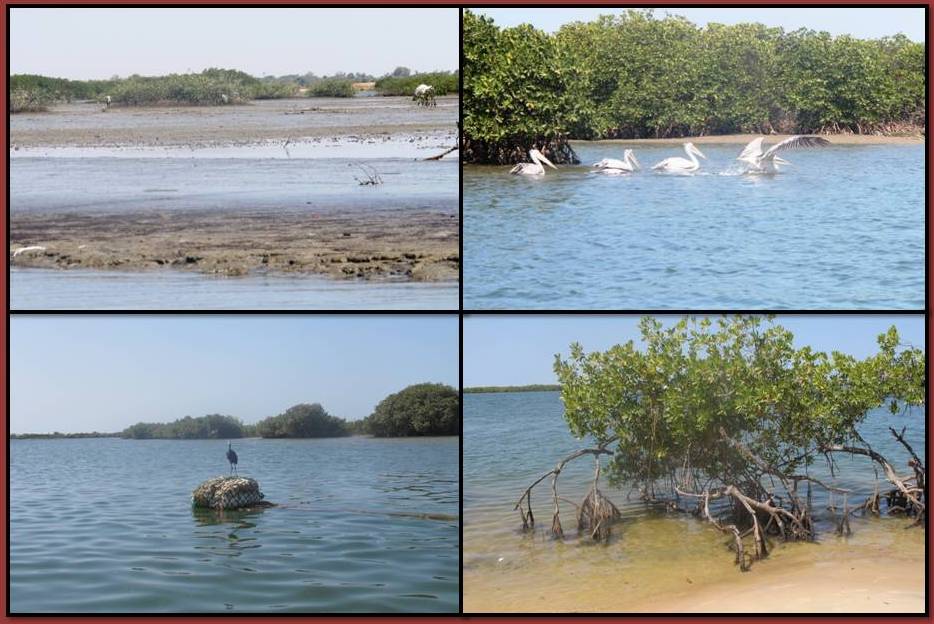
So, the driver found the way to Ndangane where pirogues were waiting for a tour of the delta. Again, birds, birds… and another sacred baobab. The mangrove was covered by shells, oysters… Some foreign sailing boats had managed to find their way into the delta.


On the island Mar Lodj there are a few small simple hotels and restaurants. After a walk over some sand dunes, a little peaceful little village offers a church, on the central place three intermingling trees - representing the three present religions, Christianity, Islam and Animism – and an open air local little “palace of justice”.


After this and almost three weeks, time to take the road back to Dakar and a flight home. I really hope to be back to Senegal one day for what you can see and discover, but especially for the friendly, smiling, people - maybe especially the kids!