Showing posts with label Paris 4. Show all posts

14.11.19

Place de la Bastille – Revolutions


The Place de la Bastille is of course quite directly linked to the 1789 Revolution - the destruction of the 14th century fortress, used as a prison, which was stormed on July the 14th, 1789. I have written on the Place and the fortress several times, e.g. here and here.

The Place is now under reconstruction, meaning that cars and buses will have to take new paths and that pedestrians will be more welcome. The work is  not finished, but you can already now reach the “July Column” on foot without risking your life (which I once did), as was the case when it was still surrounded by hectic traffic.

Some of the floor slabs around the Column have figures referring to different French Revolutions (there was not only the 1789-one)…

… and different symbols, referring to the Square. The elephant actually stood here beginning in 1813, but only in plaster and in 1840 it was replaced by the “July Column”, still there – using the same circular basin as its base. (The elephant stayed in place another six years.)

Maybe this is a good reason to write a few words about these different Revolutions? 

1789 may not need any explanations. That is the Revolution we all know about, the one which overthrew the monarchy (for a while), passed the “Declaration of the Rights of Man and Citizen”, but also created the “Reign of Terror”, the guillotine… 
  
The 1830 one, the second French Revolution, is often referred to as the “Trois Glorieuses” (Three Glorious (days)). Yes, actually, it lasted only three days, July 27-29. Charles X, who was the youngest brother to Louis XVI, had taken a number of unpopular measures, known as the “July Ordinances”, involving the dissolution of the Chamber of Deputies, the suspension of the liberty of the press… He called for new elections, but the middle-class could not vote anymore. There were some riots… and Charles X was forced to abdicate. He was replaced by Louis Philippe. The House of Orléans took over from the House of Bourbon and some new rules for the Monarchy, the “July Monarchy”, were established. The “July Column” was ordered… and Eugène Delacroix made his most well-known painting, “Liberty Leading the People”.

The “July Monarchy” lasted until 1848, when it was time for the “February Revolution”. It led to the overthrow of the King, Louis Philippe, and the creation of the Second Republic.  However, the government’s very conservative politics led later that year to the unsuccessful “June Days Uprising”, creating 5.700 victims, and in December the same year led to the election of Louis Napoleon Bonaparte (nephew of Napoleon I) as elected President of the Republic. Four years later he suspended the elected assembly and established the Second French Empire and became “Emperor of the French”, Napoleon III, the last French Monarch (1852-1870). We can see the famous caricature (The Pear) of Louis Philippe by Honoré Daumier, dated already 1831. 1848 was by the way a year of upheavals all over Europe, with France beginning in February, tens of other European countries followed with demands for democracy, freedom of the press…

So, we come to the last Revolution (1968 doesn’t count?), in 1871, referred to as the “Paris Commune”. The Franco-Prussian War in 1870 had led to the capture of the Emperor Napoleon III and the creation of the Third French Republic. The armistice with Prussia led to a disarmed Army, but the “National Guard” was there to keep order. The “National Guard” was some kind of reserve force, based on “active citizens”, including all “able-bodied citizens capable of carrying weapons”. The government had left Paris for Versailles and the “National Guard” took over the control of Paris, including most of the ministries. They came in conflict with the government and the regular army. The “working class” was largely represented and many socialist ideas were defended. They tried during their short 60-day “reign” to e.g. establish the separation of Church and State, the abolition of child labour… In the beginning, the regular Army members had no wish to go against them, but … finally, after a lot of barricades, fighting… the official government forces took over. The last resisters were killed at the Père Lachaise Cemetery (see previous post).  The figures vary, but, at least 10.000, maybe 20.000 people were killed between March 18 and May 28, 1871.

Edouard Manet illustrated.  


3.10.19

"Célestins"


The “Caserne des Célestins” is where you find the headquarters of the “Garde Républicaine”. Passing by the other day, I was struck by the extraordinary decorations of the main building, the entrance…

But first, maybe some information: 

The “Garde Républicaine” (Republican Guard) is part of the French Gendarmerie and, in its turn, part of the national police forces. Their responsibilities include guarding of public buildings in Paris, like the residences of the President and of the Prime Minister, the Senate, the National Assembly… They also accompany the highest national personalities and important foreign guests (“state visits”), including with horses, music… 

Maybe some explanation with regard to the name of these headquarters. “Caserne” is obviously translated into “barracks”. “Célestins” refer to monks belonging to a religious order, created in 1254, by a man called Pierre de Moron and who became Pope under the name of Célestin V.  Why give such a religious name to some military barracks? Well actually this is where, until the French Revolution, you could find the Convent of the Celestines. Created during the 13th century, it disappeared thus with the French Revolution. The area was then used for different activities until it was decided to build the present barracks, completed in 1895.

We can see on the maps below - one from 1780, the other one from today - which area the convent covered, compared with the present barracks. The Boulevard Henri IV was created during the 1870’s and changed the physiognomy of the area. Also, we should know that the Canal Saint Martin with its Port de l’Arsenal was created only in the beginning of the 19th century. One detail – we can see the roof of the horse riding course, by Eiffel, originally placed elsewhere for the 1889 World Fair, then moved here.  

So, as we can see - the buildings, the main entrance… are extremely well decorated. This is just the outside… maybe one day I will try to get inside!


26.8.19

650 years old (about)


I have made several posts about the Philippe-Auguste wall, built during the years 1190-1215, and also about the several places where you can still find some remains (see here). The Philippe-Auguste wall was later followed by a Charles V-wall, built during the years 1356-1383 … and of course by other later walls.

The Charles V-wall was actually only constructed on the Right Bank, the Left Bank was still left with the Philippe-Auguste wall. On the Right Bank, the two walls were linked by additional walls, more or less following the Seine banks.

As I indicated above, the Philippe-Auguste wall is still visible at many places in Paris, whereas until recently I only knew about a visibility of the Charles V-wall in the Carrousel du Louvre (see a previous post). But now there is another part visible. Recent modifications of a little square in the 4th arrondissement (Place du Père-Teilhard-de-Chardin) made the wall visible, and before covering the place, an opening was made enabling a public view of a little piece of the wall.

Maybe the rough indications of the two walls I made on the Google map would make it easier to understand what I tried to explain above.

The square (see previous post) has now lost the statue of Arthur Rimbaud, but I found it on the Seine banks during a recent walk (see here) - instead a walkway is now indicating where the wall is buried.

A late 16th century engraving shows quite well what Paris once looked like with the two walls. We can also (again) see the three uninhabited islands, Île Notre-Dame, Île aux Vaches and Île Louviers.

The two first ones were brought together in the beginning of the 17th century together and became Île Saint-Louis. It was as late as in the 1840’s that the space which separated the little island, Île Louviers, from the mainland was filled. So, we can remember that walking on the little square today, we would some 180 years back have been on the Seine banks.

The City has, kindly, made viewable a little part of the wall and visitors can by some photos, illustrations and text learn what I have tried to explain above.   


15.4.19

Too much...?


This “hôtel particulier”, a former private mansion house – now a school – is very rich on decorations, maybe a little bit “too much”?


Well, it has not always looked like this, the building has been transformed during the centuries. The original building dates from the 16th century and has changed owners – and shape and decorations… - a number of times. It is today known as “Hôtel Fieubet”, but has also been known as “Hôtel Combourg”, “Hôtel Lavalette”… Below we can see some illustrations of the building I have found (stolen) on the net. It should perhaps be mentioned that in the early 19th century it was during a few decades used as a sugar refinery. The present look dates mostly from around 1857, when it was bought by a Count Lavalette who had it rebuilt and decorated in the present showy neo-baroque style. 20 years later the building became the school it still is. The interior was for long known to have been splendid, but today…?

We can see the names of some of the occupants on the walls of the building.


The place where you find the building gives me a reason to talk about the area where you find it. The area you can see inside the red dotted lines was once referred to as “Hôtel Saint-Pol” (Saint Paul) and was occupied by royal residences – several and separate buildings for the King, the Queen, the Princes… - during the reigns of Charles V and Charles VI, meaning during the late 14th and early 15th centuries. We were then just outside the "Philippe-Auguste Wall" (see different posts here) and a new "Charles V Wall" was being built.

The name “Saint-Pol” has its origin in the Saint-Paul church which already stood there and was destroyed only after the 1789 French Revolution. (I talked about it in a previous post, see here.) 
   
The area then fell into ruins and was during the 16th century sold in parcels… and this is where, in one corner, we can find the “Hôtel Fieubet”.


11.4.19

The Anne-Frank Garden ... again.


In November 2010 I already wrote about the little Anne-Frank Garden (see here), so well hidden behind some buildings that very few people manage to find their way to it, although so close to a place which receives a lot of visitors, the Centre Pompidou (see my previous posts).  

In my previous post I wrote about the chestnut tree that Anne had been looking at “nearly every morning” and which was blown down by a storm in 2010, but of which a graft had been planted here, when the Anne-Frank Garden opened in 2007. I took photos of the little tree, thus in November 2010 … and now we can see how the tree has grown.

Something which is new in the garden since my 2010-visit is a double sculpture by the German artist Aleander Polzin, to honour the memory of the Jewish-German-Romanian poet Paul Celan, who had been in camps, lost his parents during WWII, and who later lived and died in Paris. One can see a seriously tortured man and an immobile woman, with her hair covering her face, unable to see and  to act.

In the garden (from where you can see a little corner of the Centre Pompidou) very few people were around last Saturday morning – two kids with their dad…

… but one could admire all the trees in blossom!       


8.4.19

An ecological little garden


I already posted about the “White Coats” – “Blancs Manteaux” in French. I’m not going to repeat what I already wrote here and here, just say that this refers to some monks, dressed in white. They also gave the name to a street, rue des Blanc-Manteaux. We are in the Marais area - at one end of the street you can see the covered market building which also bears the “Blanc-Manteaux”-name and, at the other end, the “Centre Pompidou” (see posts here) is more or less visible.

We can see the open space, the little garden and playground, where once the monastery used to stand. The 17th century church is still there.

There are a number of shops, galleries and even a quite well-known little theatre along the street.

The street crosses another street, rue des Archives, and you can see an example of the “LGBT” coloured pedestrian crossings which are quite common in the Marais area.

There is an old school building – you can read 1842 on the front. During the weekends the doors are open and you can get through to the other side…

… and find a garden. It’s a very special garden – it’s taken care of by an association, “Les Acteurs du Paris Durable”, in a very ecological way.


We can see a good ecological example with a lady, living in the area, bringing in what is left when she has peeled her potatoes and carrots. One day it will be fertile earth.   

21.2.19

Another little night walk


I took a nice little night walk again, maybe less spectacular to the eyes than my recent walk along the Seine River (see here).

I started at Place de la Bastille (see previous posts). The Bastille Opera has since the end of last year an illumination, named “Saturnales”. Why this name? Why not - “Saturnalia” was some kind of Roman winter celebration, in December, a short period of great festivities, when even the slaves had some kind of limited freedom…   

I continued along the rue Saint Antoine, since “forever” the major way to enter Paris from the east.

You pass by the statue of Pierre Beaumarchais (1732-99), a man known for an enormous amount of activities, but today perhaps best known for having created the Figaro plays, later linked to Mozart. The “Temple Sainte Marie” is a former catholic church, given to the Protestants during the 19th century – and of course, differently from the catholic churches, always closed except for masses. There is also the 17th century “Hôtel de Mayenne”, today a school. The doors to the “Hôtel de Sully” were closed. During day time, when the doors are open, this is one of the nicest ways to reach the “Place des Vosges” (see here). 


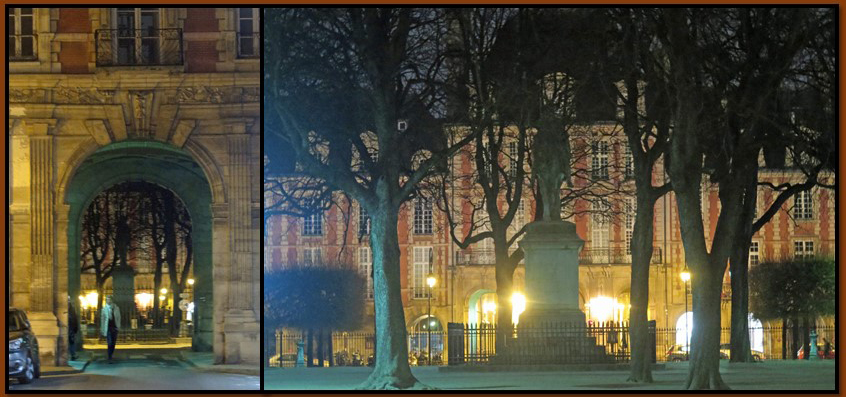
I took a little side street instead to have a short glimpse at the “Place des Vosges”...

... and another one to see the “Place du Marché Sainte Catherine” (see top picture)… and I also looked at some other side streets.

What I appreciate is that the street lamps in this area, and also in many other Paris areas, are maintained in a style which seems to fit the old surrounding buildings, a feeling of gas lanterns.

Most of the bars were closing when I made my walk. Unfortunately I could also see some traces of crushed windows, traces of some recent demonstrations.  

I finished my little walk, after having passed the “Saint Paul Saint Louis Church” (see here). It was not very late, only a quarter to twelve, but I decided to take the metro and go home.