Showing posts with label Paris 14. Show all posts

26.9.19

Red men...


I found a red man among the trees close to the Paris Observatory (see previous post).  Actually, he stands on a pedestal, on which you, until 1942 and the Nazi occupation, could find the statue of François Arago (1786-1853), a man with a lot of activities, but his statue was obviously placed here, close to the Observatory, due to his being – also - an astronomer, known for his works on the (French) meridian. I talked about it and on him several times, e.g. here.

I found out that the red man, sniffing some kind of a flower, was placed here, very unofficially, by an artist called James Colomina… and then I learnt that he had placed another (little) red man on the Pont Mirabeau.  

I have already posted about this beautiful bridge, built during the last years of the 19th century (here and here), but I felt that the bridge was worth some more photos. Those days, the decorations were important - there is even a man with a (tagged) flame… reminding us that we can see another flame close to the neighbouring bridge (see posts e.g. here and here).  


On my way to the second little red man, I felt that I had to take some photos of the Seine banks under a particularly blue sky.  

5.9.19

A new museum


The lion we can see in the middle of the Place Denfert-Rochereau is referred to as the “Lion de Belfort”. There is an original version, in stone, to be found in the city of Belfort in the east of France. It was created by Bartholdi, even more famous of course as the creator of the Statue of Liberty (see here and here). The lion was meant to be a symbol of resistance - the city of Belfort avoided, thanks to a long resistance, being taken by the Prussians in 1870-71. The resistance was headed by Colonel Denfert-Rochereau who thus gave his name to this place, where we find two lodges of the toll barrier called the “Wall of the Farmers General”, on which I have posted e.g. here, here, here and here and which were in operation until 1860.

Today one of the lodges houses the entrance to the Catacombs (see post here). The other one has now just opened as the “Liberation of Paris Museum” It also has the subtitles “General Leclerc Museum” and “Jean Moulin Museum”, referring to two heroes of the French Resistance and the Liberation from the Nazi occupancy. This museum existed on a smaller scale before, but opened here August 27 this year on the 75th anniversary of the liberation of Paris.

The choice of the place is quite obvious as we are on top of what, deep underground, (on the same level as the catacombs) was the Paris headquarters of the “FFI” – “French Forces of the Interior” -  led by Henri Rol-Tanguy (1908-2002), who has given his name to a small part of the avenue which arrives between the two toll lodges. The avenue is the one on which the liberation troops led by General Leclerc (Philippe Leclerc de Hautecloque, 1902-1947) arrived in Paris. Due to the recent celebration of the 75th anniversary of the Liberation, there are still some French flags lining the avenue, Avenue du Général Leclerc.


We must remember that the catacombs and the "FFI" premises that we find underground are only a very small part of an enormous tunnel network, originally stone quarries. To visit, you have to go deep down - there are some very impressive stairs.


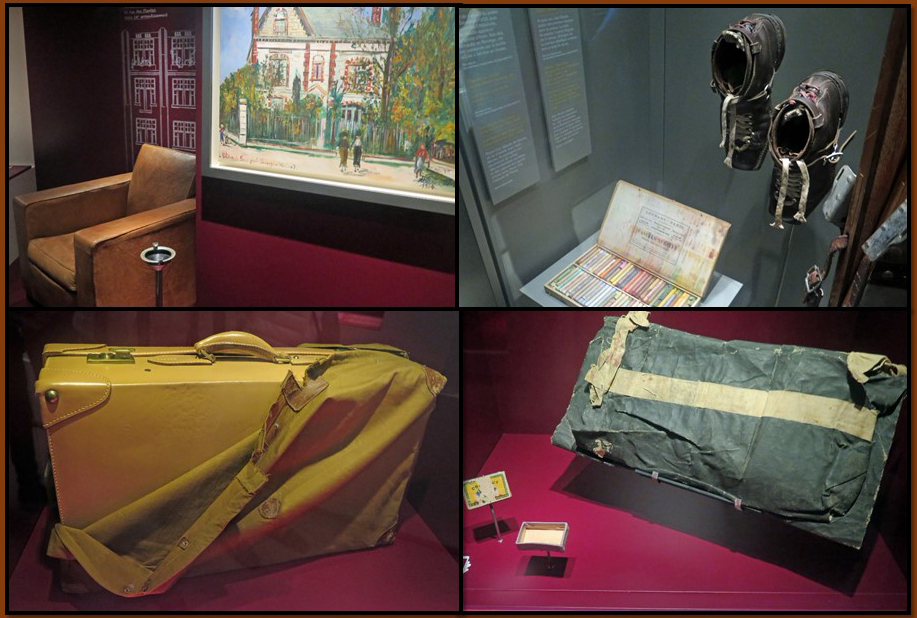
Well, I’m not going to tell here all the details about the museum, the collaboration, the resistance, the liberation… I guess that some illustrations of what can be found in the museum tell enough. 


We can see a number of things having belonged to General Leclerec…

… and to Jean Moulin. We should remember that he was not only a high-ranked civil servant before the War, he was also a good artist (cartoonist) and during the War he also opened an art gallery (in Nice) for a while as a “cover”.


30.5.19

Rue Didot and around


Rue Didot is a quite « normal » street in the 14th arrondissment. What is also normal in this arrondissement is that, looking to the right or the left, you will find a number of small streets and  alleys… Rue Didot crosses also “La Petite Ceinture” (the “Little Belt” – see previous posts here) which also here soon will be made into a nice walking space.

All the little side streets and alleys are covered with cobblestones, even being renewed.

It’s obvious that many of the buildings have been workshops, some have been, or are, artist studios…

… like this – modern – one. Looking through the front windows I could see Winston Churchill in a plaster cast version. It became obvious that this must be the studio of Jean Cardot. You can find the statue of Winston close to the Petit Palais (see here and here). Cardot is also the one who e.g. made the statue of Charles de Gaulle, in front of the Grand Palais (see here) and of Thomas Jefferson in front of the Palace of the Legion of Honour (see here).

Wikipedia states that a building in another little alley should have been the place where another sculptor, Auguste Bartholdi, made the first version of the Statue of Liberty. This seems more than doubtful… the years, nothing corresponds. Well, I have talked about this statue a number of times (see e.g. here and here)

Well, there are some flowers around also.


Someone found and uses an Italian mail box.

Here are a few more, general, views from the different small streets and alleys - Villa Collet, Villa Deshayes, Villa Duthy, Villa Jamot, Villa Mallebay, Rue Ledion…


One of the nice little houses was once the home of a leading WWII resistant, Raymond Losserand, who was caught and shot by the occupants in 1942. His wife, Louise, was also captured and was deported to Auschwitz, later to Ravensbrück and Mauthausen. She survived. There is now a Rue Raymond-Losserand in Paris and also a little Place Louise-Losserand.

In the southern part of Rue Didot there used to be some industrial and hospital buildings, now partly transformed to more social and even some artistic activities - the Red Cross is also present.   


27.5.19

Montparnasse Cemetery... again


Eleven years since I made a post about the Montparnasse Cemetery (see here), so maybe time for a little more…? 

I somehow feel that the more or less abandoned graves often are the nicest ones to look at. The red roses on the top picture were on such a tomb. Here are some more examples:


There is a special event around a tomb which was abandoned for many years, but not anymore. It seems that the Romanian sculptor, painter and photographer, Constantin Brancusi (1876-1957) made some 40 versions of a sculpture named “The Kiss” and one of the earliest ones – the only one where you can see the kissing couple in full – was in 1911 placed on the tomb of a young Russian lady, Tatiana Rachewskaïa, who committed suicide for (lost?) love at the age of 23, in 1910. The only known portrait of her is to be found on her tomb. Her Russian family obviously more or less forgot her until they realised that similar sculptures by Brancusi today are sold for tens of millions of dollars or euros. For a couple of years there has been a lawsuit between the City of Paris and the family regarding the ownership of the sculpture, which now is hidden in a wooden box … and the tomb is surveyed by a number of cameras.

I'm not going to make a more or less full report on the about 35.000 tombs at this cemetery and I already talked about some of them in my previous post (eleven years old post), but just remind you about how this cemetery is to be found in the shadow of the Montparnasse Tower (see previous post).

Here are just some random tombs and some small extra decorations to be found on top of some of them...


... and some additional photos of a snail on a flower and one of the spectacular adornment, "The Bird" by Niki de Saint Phalle, on which I already wrote in my previous Montparnasse post.

There are hundreds of celebrities buried here and in my previous post I already talked about some of them. I could not avoid showing some of them again and also some "new" - the most recent personality is obviously Agnès Varda.