Showing posts with label Petite Ceinture. Show all posts

16.5.19

Half-an-hour's green walk in the 16th arrondissement


Yes, in the middle of the 16th arrondissement, you can have a nice green walk, completely away from traffic. We are again on the abandoned rail tracks of “La Petite Ceinture” (the Little Belt) on which I have talked a number of times, e.g. here, here, here and here. This part is between the former stations “Passy-La Muette” and “Auteuil”.


These station buildings – from 1854 – are now both restaurants. The rail traffic stopped in 1985 and the tracks disappeared in 1993.

We can see “Passy-La Muette” as it once looked when even visiting royalties arrived here…

… and also the “Auteuil” station as it once looked. In 1962 this became an end station, the continuation of the line southwards was demolished.  

Yes, this is really calm, you hardly meet anybody, even a nice weather day.

You walk on ground which is a mixture of fallen leaves and needles, surrounded by traces of the original gravel.

The “nature” is half-wild – well under control, in an ecological way. There are some benches, waste is taken care of…


You can see how nature takes over even on the tree stumps.

As all over Paris there are homes for birds and insects … and under the insect-hotel, even a home for hedgehogs.

There a few discrete flowers…

… but, maybe, the best views are when looking up.


18.4.19

Abandoned tracks


The « Small Belt », la « Petite Ceinture », the circular railway on which I have posted a number of times, e.g. here, here, here, which was supposed to supply the city’s fortification walls and also to connect the different railway terminals, was created in the middle of the 19th century. Some smaller parts are still used, but the major part has been abandoned since the 1930’s, when the metro system had been developed. Some of the local stations are still around, but today used as shops, restaurants…, see one example here.

The abandoned tracks are more and more opened as some kind of “green space”, where you can walk around, see e.g. here. Another little part was recently opened, close to the Parc de Belleville (see here).   


You are not allowed into the tunnels. You can see that before the official opening, the tracks have been occupied by squatters. There is a lot of tagging, the (now) closed gates to the tunnels are painted in the “LGBT” colours…


There are a few flowers… and soon, I hope, there will be more!

11.2.16

Another part of the "Petite Ceinture"


I already wrote a few times about the “Little Belt”, the “Petite Ceinture”, the railway that was created around Paris in the middle of the 19th century to interconnect the then newly created major railway stations and also to allow travelling around Paris - before the creation of the metro system. (I already wrote about it e.g. here, here, here, here and here.) Most of it is abandoned, but to a large extent the tracks, the bridges… are still there, awaiting a possible new utilisation.

The other day I made a little walk along part of it, starting at the Villette basin. What I first discovered was that something existed in the vaults under the railway tracks. Well, does it really exist or not? I saw nobody… but there are several Internet sites about “La Vache Bleue” (The Blue Cow) and several coming events are announced (see e.g. here and here). It’s a place for different artistic activities. I have to go back, maybe during the warmer periods of the year.


I found these inscriptions on the walls, which may indicate that the activities are threatened, but found nothing on the net that confirms this fact.   

Following the tracks you will find the old railway station “Pont de Flandres”, open for passenger traffic 1869-1934.


A bit further away, just before the abandoned “Petite-Ceinture”-tracks disappear underground, you can now find the newly opened and almost completed, metro-tram-railway station “Rosa Parks”, serving the partly parallel railway lines connecting Paris with the eastern suburbs. (I wrote about Rosa Parks recently, see here.) The whole area, formerly very industrial, is under reconstruction into a mixture of housing and offices.  


13.3.14

"Walk the line" - along the "Petite Ceinture"


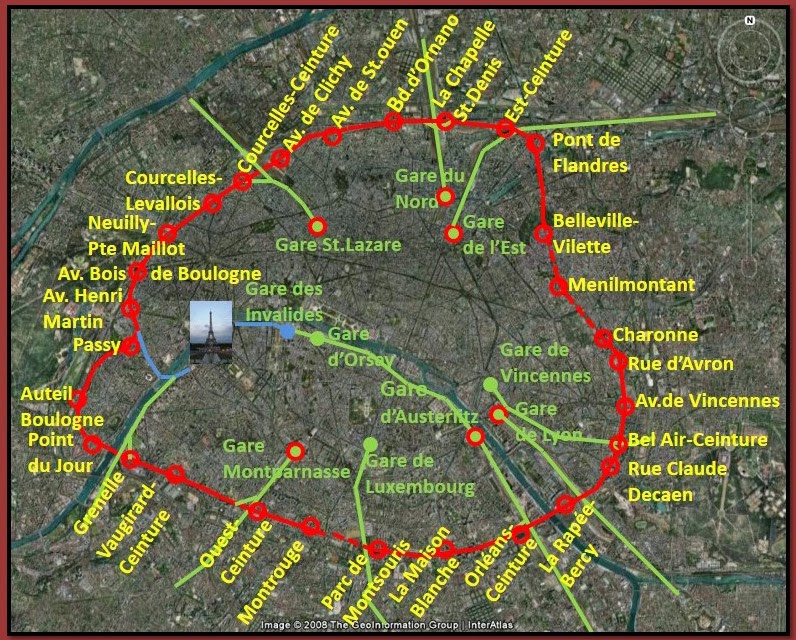
When rail transport developed in the middle of the 19th century, the different railway station in Paris were serving different more or less independent lines, specialising in different directions, to the west, to the north, to the east, to the south. The government had military reasons to wish interconnections between these independent lines, but there was obviously also a need for passengers transferring through Paris e.g. from the west to the south to reach the other station without getting lost in the city traffic, still horse ridden. Between 1852 and 1854, most of the connections were created, by what was to be called the “Petite Ceinture” (little belt). Some additions took place until the end of the 19th century. As from 1900 and the following decades, the metro system was built and the “Petite Ceinture” lost its importance, to finally be more or less abandoned in the 1930’s. Some smaller parts were used later and today an express metro line (RER C) is using part of the western “Petite Ceinture”, but most of the tracks are abandoned. In red you can see the "Petite Ceinture", in green the different intercity lines and stations of which today remain Gare Saint Lazare, Gare du Nord, Gare de l'Est, Gare de Lyon, Gare d'Austerlitz and Gare de Montparnasse


Some of the numerous stations have been transformed to restaurants, shops… but many are also just abandoned and wait for demolition or better use. Here are some views of what the old railway line looks today, partly abandoned, partly covered… and to a small extent open for walkers. (Some other views to be seen in a previous post – here.)


A new part of the “belt”, in the south, was opened to public late last year. I took a walk – a dark and dull winter day. (Compare with the old steam train on the same trace some decades ago.)

There were some ideas to make use of the “Petite Ceinture” with its tracks and tunnels, when it was decided to build a tramway (partly opened in 2006, works still ongoing) more or less following the same trace, but for some reasons (connections to the metro system…) it was decided to build it in parallel, following the Boulevards des Marechaux (Marshals).


One of the stations, “Vaugirard-Ceinture” is still there, today partly used for private flats, partly for different social activities.


You can follow the trace of an old bifurcation, alongside some new apartment buildings, leading to a metro workshop (today connected differently, underground). 


Since I took these photos, the landscape has clearly changed. Once more, I would like to show some Paris spring sights - from yesterday.


29.5.09

Boulevard Péreire


I have already at a few occasions (I refer e.g. to my post about Gare du Nord) talked about the circular railroad, “La Petite Ceinture” (The Small Belt), created during the latter half of the 19th century, just inside the then relatively new Thiers Wall (see previous post) which surrounded the city still for a few decades. This was before the opening of the metro and there was a need to connect especially the more important railway stations.

With the time, now and then, I may bring you on a complete tour of the “La Petite Ceinture”, progressing slowly; although it’s basically not more in operation since the 30’s, the traces are there, parts of the rail tracks are still used for the rapid metro lines (RER) and some stations are still in use, sometimes as shops, sometimes as restaurants .... sometimes as metro stations.

Today I would like to take you along for a little part of the “Ceinture”, the Boulevard Péreire. It has got its name from the brothers Péreire, of Portuguese origin (Pereira), financiers involved in banking, steamship lines, insurance, newspapers... railways and the local transport systems. They owned the railway line which used to pass here.

You can follow the boulevard from Porte Maillot, its large hotels, congress building, restaurants....
In the beginning, the space between the buildings on both sides of the boulevard is today covered by a park with a still working quick metro line (RER) below. (See top picture. Some of these photos were taken last year – under the sun, absent during my walk this week.)

On our way, we will cross Place du Maréchal Juin and pass by the station Courcelles-Levallois (covered by tennis courts). As from here the metro takes another direction and the old “Petite Ceinture” rail tracks, not used any more, become visible (see the pictures with the plan above) although largely hidden by growing trees. We will cross Place Wagram and end up close to the tracks that lead to Gare Saint Lazare.
On both sides of the boulevard most of the buildings are from around the shift of the 19th and 20th centuries. Most of them can be described as of high standard.
Many of the buildings have artist studios on the top; I guess that few artists today can afford to live here.

I wish you all a nice weekend!