Showing posts with label Montmartre. Show all posts

16.10.19

The black cat... again


Yes… again. I already wrote about the famous cabaret ”Chat Noir” here and about the monthly journal with the same name here… Last weekend, the team behind the journal met and created a bit of publicity at Montmartre. I’m not actually part of the team, but I feel that they need a lot of encouragements! 

The original “Chat Noir” journal appeared for the last time in 1895, but the publication resumed last year. In the previous version of the journal, texts and illustrations were signed Allais, de Maupassant, Hugo, Goncourt, Verlaine, Gounod, Steinlen, Willette, Léandre, Caran d’Ache… Today you find a team of enthusiastic persons behind it (who may not YET have the reputation of their predecessors) led by Romain: Rodolphe (known for the bestseller “Paris secret et insolite” and other books), Champo, Binu, Mathias, Philippe…

They all kindly signed my copy. You can subscribe, but the (very low) cost depends on in which country you live and the postage. I suggest that you send a message to journallechatnoir@gmail.com or look here.  

The sales were preceded by a meal in the famous “La Maison Rose”, painted by many artists (here Utrillo) and for a while managed by the Pichot couple - Germaine (who was the reason for the suicide of Picassos’ friend Carlos Casagenas and who appears on Picasso’s famous “At the Lapin Agile” painting, see here and here) and her husband Ramon, also a painter and friend of Picasso. The last decades “La Maison Rose” has perhaps been a bit of a tourist trap, but it’s now run by this charming lady and you can have a more than decent meal (I have no commission).  
    

9.7.18

Green space - Montmartre


I don’t know what finally will become of this little park, in the middle of Montmartre. There is in Paris a “Cité Internationale des Arts” which was created in 1965 and which offers international artists-in-residence programs. Most of their activity takes place in a modern building in the Marais district, but there are also some 35 studios at Montmartre, surrounded by green space, normally not open to public. I visited it some five years ago, when it was exceptionally open to public (see here) for a day or a weekend.

There have been discussions about a need – and a budget - to do something with this area, where today the buildings and the green space would need some “refreshing”. Words like a Paris “Villa Medici” have been mentioned, but….

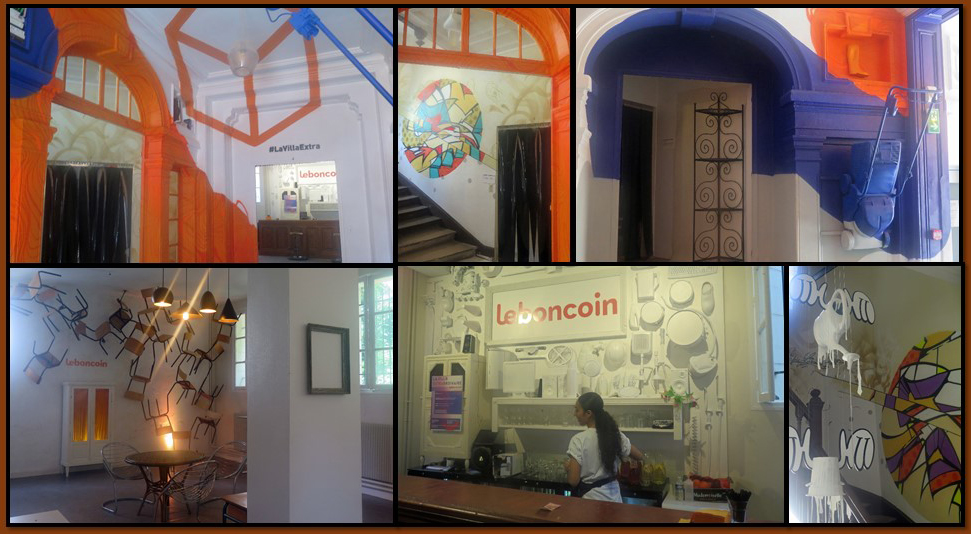
In the meantime, there have however been some more active openings to the public. There is now an event ongoing (until July 29), referred to as “La Villa Extraordinaire”. You enter via the “Villa Radet”, a 19th century building, built on the corner of the Rue de l’Abreuvoir (“abreuvoir” means a watering place – which a few centuries ago was situated where this building now stands).

This building used to host a number of artists in residence, but it seems now to be transformed to allow exhibitions, installations... This is what we can see today.


Once you have visited this building (and maybe had a glass in the bar), you can reach...

... and have a walk around the green space, where different activities are offered, especially linked to sitting down, maybe have something to eat or drink and you can of course have a glimpse at some of the old buildings, hosting artists.  


31.10.16

Montmartre by night...


Montmartre by night…

Still some limited crowds on the most visited spots…

… some people in front of the theatres, the cabaret, the cinema…

… hardly anybody in the calmer areas…


… but the numerous bars and restaurants are not empty. 


25.2.16

Sacré Coeur - from the outside only...


I realized that, after a few years of blogging, I have not made a real reference post about the Sacré Coeur Basilica. Well, one reason is of course that it’s the only Catholic Church in Paris where photos of the inside are not allowed. (The reason seems to be that the church is devoted to the Sacred Heart of Jesus, which puts it on another sacred scale than the churches devoted to just “normal” saints etc…)

You may today be a bit perplexed when you learn that the official reason for building the church was to “expiate the crimes of the Commune” (the revolutionary government of Paris in 1871). This created several years of controversy between different political and religious parties and movements. Today, the church is rather (or also?) considered to be dedicated to the 58.000 victims of the Franco-Prussian war 1870-71. Mainly financed by support from parishes throughout France, it took a few decades before it was finished, from the foundation stone in 1875 to the completion in 1914 – during WWI. It was officially dedicated only after the war, in 1919.


We should know that the surprising architecture is due to Paul Abadie, who died well before the completion of the building.

So, no photos from the inside here, but a selection of photos taken from different places in Paris under different skies. Thanks to its place on the top of Montmartre, the basilica is visible from almost everywhere.


18.1.16

Another little alley...


When you walk along the large Boulevards de Clichy, de Rochechouart… on the lower, southern borders of Montmartre (or elsewhere), you are sometimes lucky to be able to push a gate which opens, or find someone who lets you in. Here is an example. I don’t give the exact address as people who live here mostly want to be left in peace.

These little alleys, previously often occupied by workshops, are now sometimes occupied by some artists, architects… but mostly just by people who have chosen to live in a busy area, but still in a complete calm.


It’s always striking to see how these people are fond of plants… and bikes!


Here is another little alley. When you look up…. 

14.9.15

More poetry - and more ...

Last weekend I visited “Les Buttes aux Cailles” for a poetry weekend (see preceding post). This weekend I attended another event, again linked to poetry, literature, theatre… - this time in my own neighbourhood, “Les Batignolles”.

This is actually a yearly event and one particular day it allows people to sell their books… and of course to buy other ones. It’s part of a lot of other activities which are proposed by a local association, “Du Rififi aux Batignolles”, during September.

Bad luck, this year it rained a lot Saturday.

I listened to some – really nice – poetry by a young lady. The event was actually this year linked to Victor Hugo and she had brought along some kids who read some of his poems.

Due to the wet weather, what should have taken place in open space was finally transferred to one of the local cafés, generously opened. We could enjoy a nice mixture of Victor Hugo texts, with interludes by a talented young cello player.


Starting under umbrellas we then made a Victor Hugo tour, listening to Lucien Maillard, a journalist and writer, who regularly offers very interesting and extremely well documented information, this time accompanied by some wonderfully performed music. (Finally, we were spontaneously invited by one of the followers to finish the performance in her nearby flat.)  


That was Saturday. Sunday, still a bit of rain, but less. I watched a number of amateur theatre plays (excerpts). There had been a pre-selection. A number of theatre groups performed, in my mind quite professionally. There were other events proposed by Rififi, but you can't be everywhere.

One reason was that I wanted to be there when a new Montmartre project was presented.
I already posted about “The Cité des Arts” at Montmartre, see here. The idea is now to obtain an investment from the City of Paris, owners of the premises, in order to create something which is referred to as the “Villa Medicis” in Paris. This green haven - where many later world famous artists have lived and worked, where the famous first cancan dancer, “La Goulu” lived and where some 40 artist studios are “hidden” - needs to be renovated, buildings as well as the green space. The idea is also to make it more open to public, to create a place for expositions…  This is now on the list of City projects for the coming years, but it’s not the only one. There is a possibility to vote here.


30.4.15

The circus building is gone.


Unfortunately I don’t have any really interesting photos of my own to illustrate what I would like to talk about in this post – the place, the circus building, is not there anymore. 

It stood here – in the lower Montmartre / Pigalle area - for approximately 100 years, from 1873 to 1971 (1972?, 1973?). It was a circus with an interesting history.

Here we can see what it looked like.

(On the front corner there was for a long time a photographic studio – “Chamberlin – Photographie Artistique”.)

The circus was first named “Cirque Fernando”. Ferdinand Waltenberg – alias “Fernando” had created a circus in an open area in the neighbourhood, quite successful, which allowed him to finance this building. He ran it until 1897, when it was taken over by a clown he had engaged already in 1873, Géromino Medrano, and the name was changed to “Cirque Medrano”. In the 1960’s it was taken over by another famous circus family, Bouglione, and the name was, again, changed to “Cirque de Montmartre”, with less success. It was for a time also used for plays (“Théâtre de Soleil”), stand-up artists… and then sold. … and replaced by the apartment building - named “Bouglione”, the only reference to the past. (So much was destroyed during the 60’s and 70’s, today often with great regret.)

Here are some posters from the Fernando and Medrano years.

It was then a “real” circus with all kinds of animals, acrobats… and maybe especially clowns: Grock, Buster Keaton (several periods), the Fratellini Brothers, Achille Zavatta…  (One of the photos shows Buster Keaton playing cards, behind the scene, with a monkey.)

When the circus performers had their days off, the circus was often used for gatherings of different kinds, including political meetings (e.g. by Clemenceau).


But what really has created the reputation of this circus building is probably that it was visited and illustrated by a number of impressionist, post-impressionist and later artists.


Toulouse-Lautrec was probably the most frequent illustrator. Here are just a few examples.

Here are some illustrations by Degas (“Miss La La”), Renoir (the young sisters Francisca and Angelina Wartenberg), van Dongen, Seurat.

Picasso was a very frequent (and appreciative) visitor, but he tended to paint the artists back-scene.