
There are
some 270 churches in Paris intra-muros, whereof some 160 catholic, some 40
protestant, some 25 synagogues and some 20 mosques... Here is another Roman
Catholic one, actually one of Paris’ biggest, but not among the most visited –
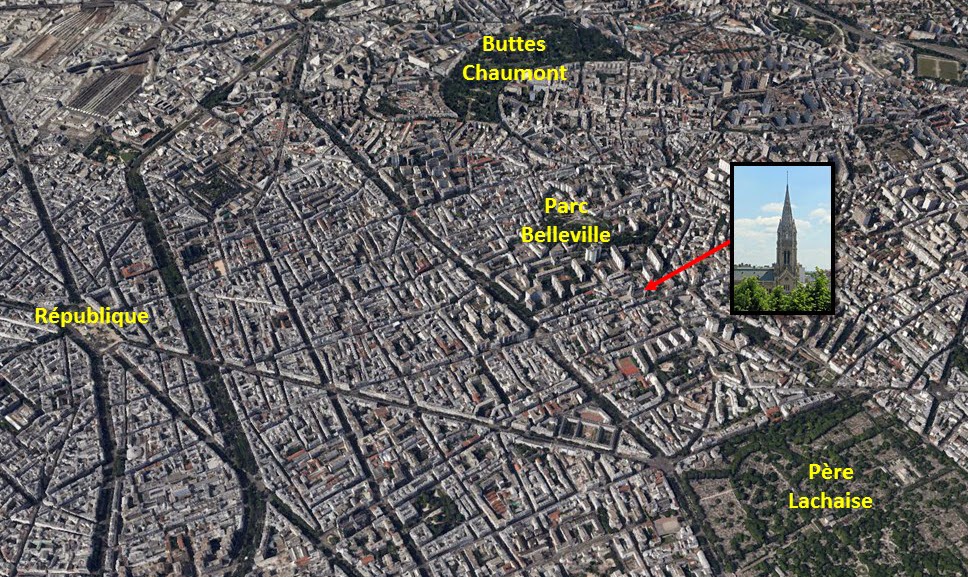
Notre-Dame-de-la-Croix, to which you could add “de Menilmontant”, a quarter in
the east of Paris on which I already have posted a few times (e.g. here and
here). Menilmontant was a hamlet, part of the commune Belleville, which
together with other suburbs was absorbed into Paris in 1860, then dominated by
a working-class population.
Menilmontant
seeing its population grow considerably as from the beginning of the 19th
century, there was a need for a church. A chapel was built, soon too small and
replaced by the present church, built during the years 1863-1880. The works
were of course again interrupted by wars and the Paris Commune in 1871 –
meetings by the communards were held in the not yet completed church… .
The design
is quite typical for churches built in Paris during these years, you may refer
to it as neo-roman with gothic elements, especially in the
interior. What especially distinguishes it
is the modern concept to use metallic visible girders. A specail word also for the organ, by the master organ builder, Arisitide Cavaillé-Coll, from 1874....

… and also,
as built on a steep slope, about the imposing stairs in front of it.

Some photos
of the interior, with a large number of paintings, sculptures…


When you
reach the bottom of the stairs in front of the church, you will find a nice
little square, named after Maurice Chevalier, who was born and started his career in the small bars at Menilmontant.


Once there, you may notice in the little garden surrounding the church, a little building, decorated by kids – tiles with pictures and texts referring to “Europe”.



 Posts




