

This is what until the 70's used to be called the "belly of Paris", when for hygienic and congestion reasons the activities which used to take place here were transferred to new premises in the suburbs (Rungis). What usually goes under the name
"Les Halles" was from the 12th century until around 1970 Paris' central market (including wholesales) for fresh products. During the second half of the 19th century the so famous "Baltard pavilions" were constructed, thus demolished during the 70's. Several projects were planned and even launched and abandoned for new activities on this large area. In the meantime, and for years, this was known as "le trou (the hole) des Halles". Finally it became what you may call a park, covering an enormous shopping mall... and often critisized. Many regret the old pavilions; one of the twelve was saved, transferred to a suburb (Nogent) and now used for different cultural events.
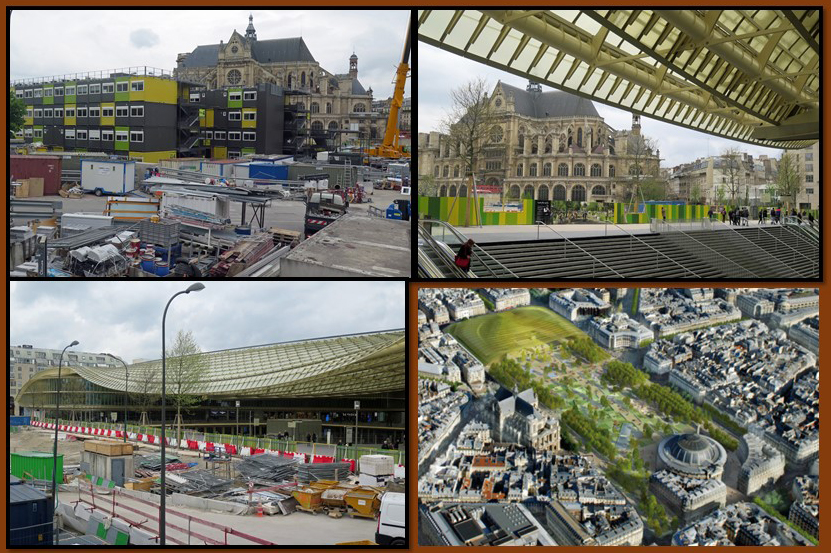
The total of the present installations were completed around 1985, but there are now already fixed plans to again remodel the area, the "Canopée" project, which will start in 2010 and probably last a few years.
(You can read more about it here.)
One of the previous buildings was left, the "Halle aux Blés (wheat)", built in the 1760's replacing a castle, sometimes used by Royalty, including by Catherine de Medicis, and from her days remain the "astronomical tower" (from 1574). This is today the "Bourse de Commerce".

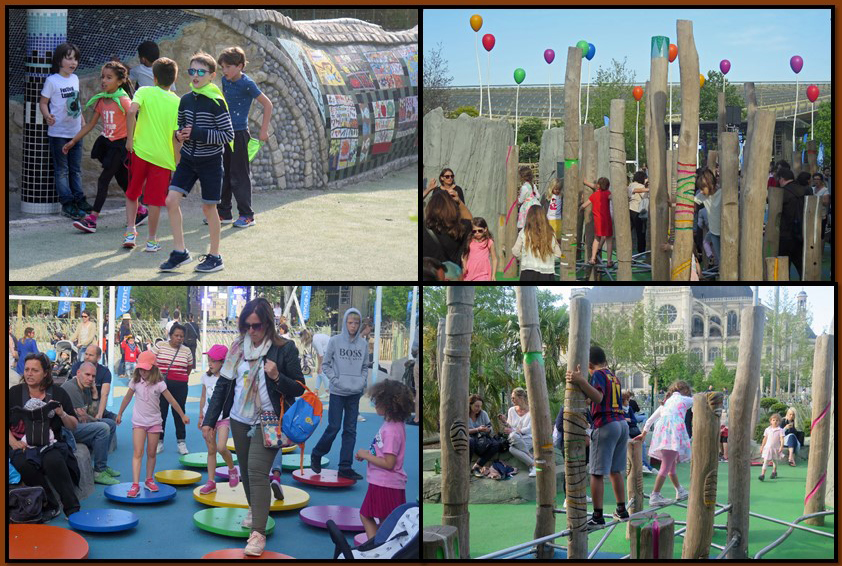
Awaiting further transformations, the park and the shopping mall are there. On a sunny spring day the park gives quite a nice impression. Some constructions were made to recall the former pavilions. You can find an outdoor labyrinth for kids in jungle-like landscape. The area is quite green ... and there are a lot of flowers.


A cascading series of steel-framed glass windows opens on part of the underground area with annually some 40 million visitors, full of stores, shops, bars, movie theatres, museums, discotheques, a large swimming pool...


On the very lowest levels you will find what is supposed to be the world's largest underground station,
Le Châtelet. Long corridors connect you between five metro lines, three high speed (RER) metro lines... If you decide to meet a friend at a metro exit - here you must be very precise, there are 14 of them.

Around "Les Halles" there are some nice older parts and some famous brasseries. One of the neighbouring streets (Rue de la Ferronière) is where one of the most popular French Kings, Henry IV, was killed in 1610 (by François Ravaillac). Immediate neighbours are also the pedestrian Rue Montorgueil
(see previous post), the Square des Innocents
(see previous post) and of course the Saint Eustache Church
(see previous post).

I wish you a nice weekend!






 Posts
Posts





