Showing posts with label Swedish Institute. Show all posts

16.7.18

Swedish contemporary art.


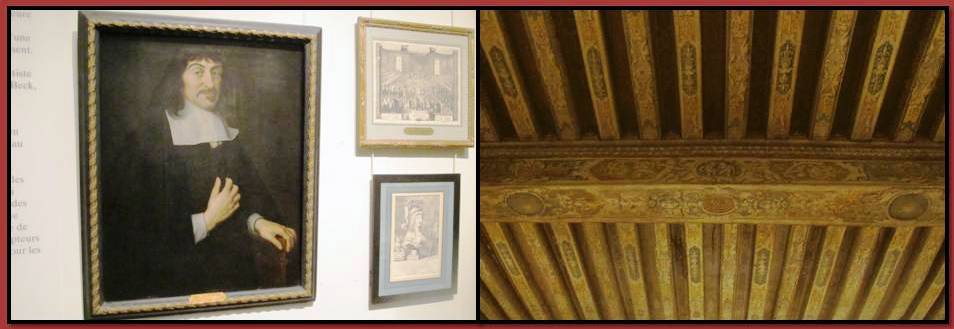
There is an inscription to be read on the ceiling, in one of the rooms of the 16th century “hôtel particulier” (town house), “Hôtel de Marle”, in the Marais area. It reads “POST FUNERA FIDUS”, which, if something remains from my Latin lessons, should mean something like “after death, faithful / loyal”.  It seems to be a message to the father of a son who inherited the place. Well, this has actually nothing to do with what I wanted to report about, but... 

Under the beautiful ceiling…

… there is now an art exhibition ongoing – until August 26.  We are in the “Institut Suédois” (Swedish Institute) and the works of some contemporary 30 Swedish artists living in Paris are exhibited.  You can read more about the Swedish Institute here and about the art exhibition and the artists here.

This beautiful building was bought by the Swedish State in 1965, was heavily renovated and is open to public since 1971.  I already wrote about it several times, e.g. here, here and here.

The exhibition opened by a vernissage, July 11, in the presence of almost all the artists. We can see them (top left) standing on the stairs leading to the beautiful garden. The official opening was declared by the Swedish Ambassador, Veronika Wand-Danielsson, and we can see her (top right) together with the exhibition curator Christian Alandente, with the head of the Institute, also Councillor for cultural affairs at the Embassy, Ewa Kumlin, with Kerstin Decroix, representing the unfortunately absent president of the “Association Artisitique Suédoise à Paris” (Riina Ingel) and with the Institute’s art project manager Marion Alluchon.

More than 500 people attended during this beautiful summer evening. Many are members of the “Association Artistique Suédoise à Paris”, others will hopefully join. (Yes, I’m on the board of the association.) The association has been active since 1957 and is there to encourage Swedish artists working and living in France. You can read about it here.   


27.2.12

The Swedish Institute


Behind this dark entrance in the Marais area is a paved court… and a 16th century building, “Hôtel de Marle” (hôtel = private mansion). It was bought by the Swedish State in 1965, was renovated during several years and opened to public in 1971 as the “Le Centre Culturel Suédois”, today  “L’Institut Suédois” (The Swedish Institute).


In the summer and during the day it looks different. You are welcome there to see expositions, have a coffee with some Swedish pastry… or just visit.


I went there the other evening, once again with my friends from the “Association Aritistique Suédoise à Paris” (see previous post) for an exhibition by some Swedish “comic strips” artists.

“Comic strips” is possibly not the best way to translate what in French is called “bandes dessinées”; this kind of art is today definitely far from always comic, funny. “Drawn strips” is maybe a better translation and what is produced today must often rather be considered as “graphic novels". There is a big market for this in France. In January there is an annual festival in Angoulème in the south-west of France, the biggest one in Europe, with several hundred thousands of visitors and where several thousands of cartoonists and other professionals meet, expose…

This year a group of Swedish artists made a special exhibition in Angoulème with August Strindberg as a common theme. This exhibition can now be seen at the Swedish Institute in Paris and that was the reason for our visit.

Do I need to say something about August Strindberg? If you wish you can go here, but just a few words: Swedish playwright, novelist, poet, essayist, 1849-1912. The hundredth anniversary of his death is thus now celebrated, including in France (expositions, theatre plays…). Strindberg spent several years in Paris and its surroundings, wrote some of his works in French, became befriended with painters and was portrayed by some of them like Eduard Munch, Carl Larsson (see previous post), Anders Zorn (see previous post)…


… and he was a great painter himself, with a limited production, often of with the sea as motive.  At least two of his paintings can be seen at the Orsay Museum.


One of the exhibiting cartoonists, whom we met, Knut Larsson, was executing another portrait of Strindberg on a wall of the stairs of the Institute. Knowing Strindberg’s excited life and excited sea paintings, it’s easy to understand why he portrayed him emerging from a wild sea.


We were guided around to see the works of the other participating artists.


Maybe some particular words about what our guide, Knut Larsson, presented at this exhibition: Strindberg much appreciated a painting by the Swiss painter Arnold Böcklin, “Die Totelinsel” (Isle of the Dead). Böcklin made five versions during the years 1880-86. The one you see below once “belonged” to Hitler and is now exposed in Berlin. One was lost during WWII, the other ones can be seen at Basle, Leipzig and NYC (MMA). These paintings later inspired a lot of people (Dali, Ernst, Rachmaninoff…), but already in 1907 Strindberg wrote a never finished play with the same name and this is what inspired Knut Larsson. There is an obvious link between this Strindberg’s unfinished play and the finished one, also from 1907, “The Ghost Sonata”, which is supposed to end with the image of “Die Totelinsel” and to be accompanied by Beethoven’s “Ghost Trio”.


At last, we went up the beautiful stairs to the upper floor for a glass of wine … and we could of course also admire the beauty of the room as such, decorated by paintings (permanently) lent by Swedish museums and institutes.


Perhaps a special glance at the portrait of René Descartes (Cartesius), painted during his short stay in Stockholm with Queen Christina, before he died there in 1650 of pneumonia during the Swedish winter…. and the ceiling, which was one of the nice surprises during the renovation of the building.