
I have
already posted about the Petit Palais, (see here), but I thought something more
had to be said and especially shown. The Petit Palais was built for the 1900
Universal Exhibition at the same time as the Grand Palais, which stands in
front (see different posts). Most of the
buildings from the 1900 Universal Exhibition have disappeared, but the Petit
Palais as well as the Grand Palais were built to stay… and they do. The Petit
Palais houses the “City of Paris Museum of Fine Arts”, and as all the
City-of-Paris museums, there is no entrance fee for the permanent collections
(which is not true for the national, private… museums). You will however have to pay for the temporary
exhibitions.
A few new glimpses of the outside with its
incredibly decorated entrance, the general richness of decorations, sculptures …


… of the
inner courtyard (where you can have a snack, a coffee, a glass of wine…)…

… of the
entrance hall and galleries, with the ceilings decorated by Albert Besnard
(1849-1934)…

… the
different stairs leading to a lower floor.

The
collections are partly based on paintings and sculptures acquired by the City
of Paris since 1870 and also to a large part on donations. They cover different
periods, but basically only until 1900… more recent art belonging to the City
of Paris is to be found in the “City of Paris Museum of Modern Art”, on which I
wrote e.g. here.
Looking on
what you can find in the museum, I could mention one large hall presenting what
mainly comes from the 1921 Tuck donation, including tableware, watches, figurines,
sculptures, paintings…


On the main
floor, there is a lot to see from especially the 19th century,
including several paintings by Gustave Courbet (1819-77) and a fabulous
portrait of Sarah Bernhardt … You may not so often see paintings by André Gill,
more known as a caricaturist… and for the “Lapin Agile” (see story here).


… and there
is more of it downstairs.


We can find
some sketches, plasters, models… for different sculptures which we in a more
permanent form can find around Paris. This goes e.g. for the “La Défense” by L-E
Barrias (1841-1905), which gave the name to the business quarters with that name
(see post here) and for the statue of “Marianne” by Léopold Morice (1846-1919) on
the Place de la République (see different posts, here and here).

Jules Dalou
(1838-1902) is represented by the then future monuments of the “Triumph of the Republic”
on Place de la Nation (see post here) and his tribute to the painter Eugene
Delacroix in the Luxembourg Gardens (see post here).

There are
other sculptures, including the portrait that Rodin made of his friend Dalou,
an impressive Chinese head by J-B Carpeaux (1827-75)…

There is a
large collection from older days, icons…

… and even
some antiques.

Unfortunately
some treasures, mostly from the 17th century, including Rembrandt,
Rubens, Poussin… were hidden when I passed by the other day (so I “stole” some
pictures from the museum site).


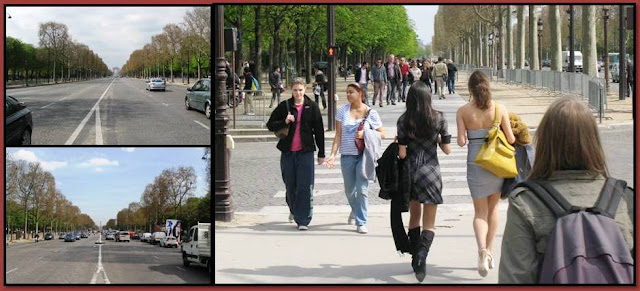
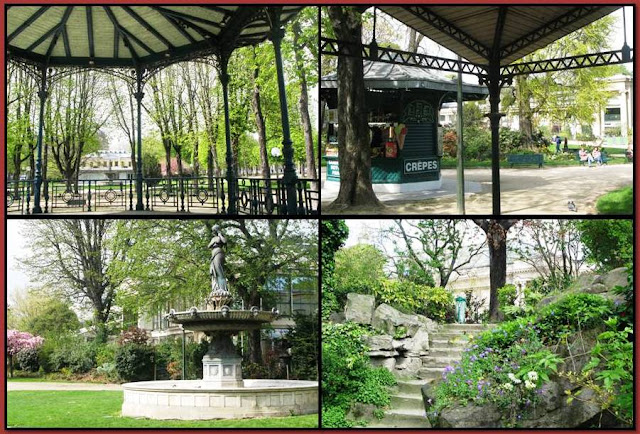

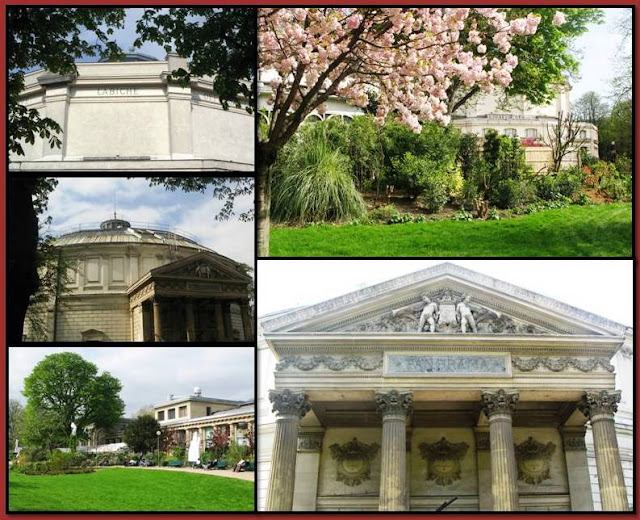 If you are hungry – and can afford it, you can also find some of Paris’ best restaurants here: Ledoyen (3 Michelin “macaroons”) , Laurent, Lenôtre.
  There are a number of fountains and statues around. Do you recognize these personalities?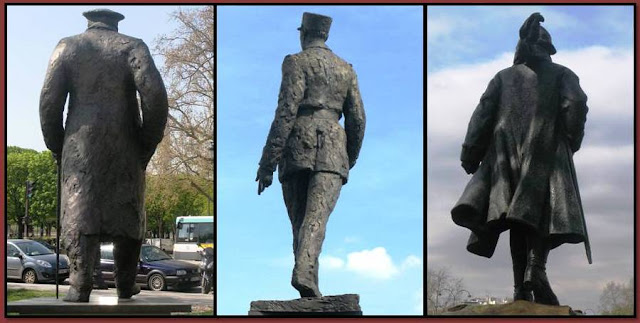

 The Petit Palais is today housing the City of Paris Museum of Fine Arts, partly used for a permanent collection (free of charge), partly for temporary exhibitions - the one ongoing at the moment is dedicated to Goya and about 200 of his etchings and lithographs.
 Inside, you can find a semi-circular garden, encircled by ionic columns. There is also a café and you can enjoy your coffee (or whatever you prefer) in the garden when the weather permits.
 The permanent collection consists of paintings (artists like Rubens, Rembrandt, Courbet, Ingres, Delacroix, Pissarro, Monet, Sisley, Renoir, Gauguin, Cézanne…), medieval and 18th century furniture, manuscripts, books… Some kindergarten kids did their best to reproduce some of the art they saw.
  Some of these pictures can be seen on my
 Posts
Posts




