21.3.13

Senegal (4) - National reserves around Saint Louis


Around Saint Louis, you can find several natural reserves. 


This first one is the Guembeul National Reserve. The place is a paradise for (migrating) birds, gazelles (oryx), monkeys, reptiles, tortoises…  The “African spurred tortoise” is the world’s largest species of a mainland tortoise and may live for some 150 years.  Fortunately I did not meet any reptiles, unfortunately no monkeys…  


A second one is the Langue de Barbarie National Park, another birds’ paradise – you are supposed to find some 160 species - another important stop on the European migration route. A tour in a pirogue is the best way to approach the birds. However, the ecosystem is changing due to the building of a narrow canal in 2003, which has since widened dramatically, bringing in a lot of salt water and tide. People live here and we can see some women collecting crabs and shellfish in low waters, children playing on the beaches…


18.3.13

Senegal (3) - Saint Louis

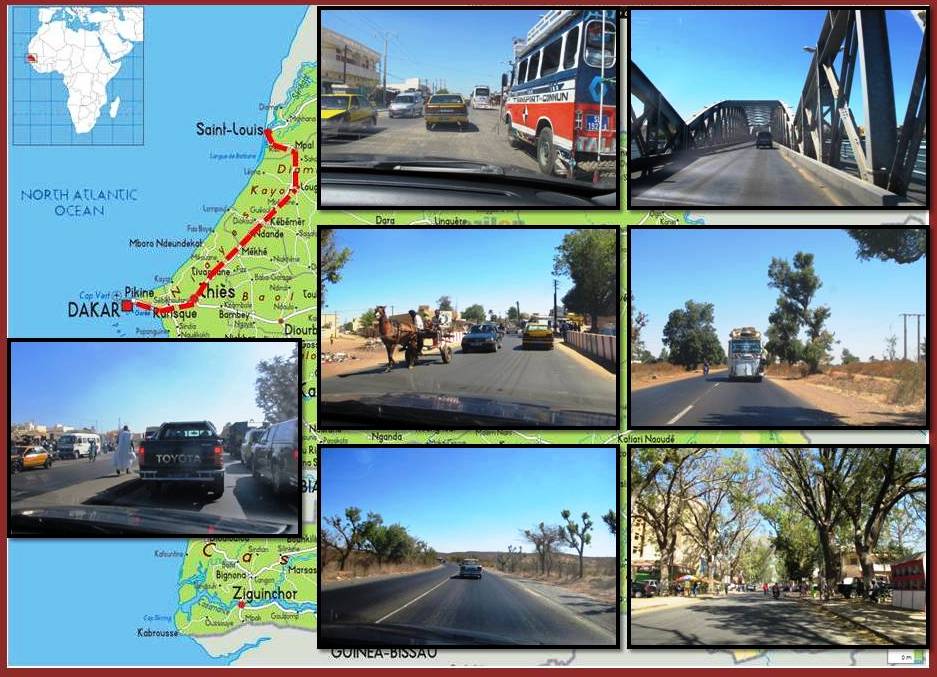
After Dakar and its Goréé Island, there was time for a car ride – some 300 km (200 miles) – to Saint Louis, in the north-west corner of Senegal, close to the Mauritanian border. After struggling with heavy traffic jams leaving Dakar, the ride was very pleasant on a nicely paved road through a Sahel landscape, the more or less desertic band that separates Sahara from the savanna. At the end we approached the famous Faidherbe Bridge.


Saint Louis was established in 1659 by French traders. It was the capital of Senegal and later of French West Africa (present Senegal, Mauritania, Mali, Guinea, Ivory Coast, Burkina Fasso, Benin, Niger) until 1902, when Dakar took over. Slave trade was quite important until its early 19th century abolition. As on the Gorée Island, it had a community of Franco-African Creole or Métis community, including the so called “signares”, women entrepreneurs.

The original city was on the little island, separated from the mainland by the Faidherbe Bridge (from 1897 – recently rebuilt in its original shape). A second bridge leads to a narrow sand slip, the Langue de Barbarie.

The Island of Saint Louis has kept a lot of its original colonial architecture, more or less in good shape, with some old hotels and as everywhere in Senegal, a mixture of mosques, a cathedral… From the western side of the Island, you can watch the urbanized part of the Langue de Barbarie.


Once crossing the little bridge to the Langue de Barbarie, completely overcrowded and mainly dedicated to fishing industry, it’s amazing to watch the hundred of pirogues landing fish and the hundreds of trucks waiting to be loaded, fish being cleaned and smoked…. 


14.3.13

Senegal (2) - Gorée Island


Ile de Gorée (Gorée Island) is reached by a little ferry from the Dakar mainland. It’s today probably Senegal’s major tourist site. It’s a small island with only some 1000 inhabitants, but it has a long history, being one of the first European African settlements. The Portuguese were the first (1444) and there were several switches between Portuguese, Dutch and British domination, until the island became French in 1677. With a few short interruptions it remained French until 1960, when Senegal became independent.

You can of course see the remains of important defense architecture.


Dakar on the mainland was founded as late as 1857 and the Gorée Island was until the end of the 19th century a very active place with a much higher population than today, busy with trades of all kinds, including slaves. Despite the fact that the island has a “House of Slaves” which serves as a memorial, the slave trade seems to have been comparatively rather limited here, much more important in the north and south of Senegal, before being abolished by the French in the beginning of the 19th century. It’s impressive to see the small “no-return” gate opening to the ocean.


But today, the island, where no cars can be found, is very idyllic.


Some illustrations of the major Senegal sports, wrestling and soccer.  


11.3.13

Senegal (1) - Dakar


So, I’m back from my trip to Senegal. Of course I can’t resist … I have to make a new exception to what normally here should concentrate on Paris.

First some general comments about the country: Some 13 million inhabitants. Independent since 1960. Beautiful country, fantastic climate during the dry winter months, smiling and friendly people... Islam is the dominating religion, but in a “soft” version and Muslims and Christians live peacefully together. French is the official language, but several other languages are present, the dominating one being Wolof.

A first post will be about Dakar, capital of French West Africa since 1902 and of the independent Senegal since 1960, with some 2.5 million inhabitants.

Of course, the city has also some modern areas with calmer streets, but as a tourist you are of course attracted by the tumultuous street life in the older parts of the city, e.g. in the “Plateau”, where I stayed in a nice little hotel. You have a feeling to be on a market place wherever you go. We shall not forget that the city faces the Atlantic Ocean; you are never far from a beach.


17.2.13

A little break...

I will again make a little break in blogging. I will be off to Senegal for some three weeks. The below photos are "stolen". I hope to be back with some of my own. See you around March 10.