Lycée Henri
IV is a public school, considered as one of France’s most demanding ones, with
some 2.500 pupils. Actually the school offers as well the four first years of
secondary education (age 11-14), “collège”, as further secondary education (age
15-18), “lycée”, preparing for the “baccalauréat”, the entrance to higher,
university, studies… but also something more particular – “classes préparatoires”,
supposed to prepare students for entrance to the elite “Grandes écoles”. It’s situated in the Latin Quarter, surrounded
by other prestigious educational establishments, including the Sorbonne.
The school
has a long history which actually starts well before it became a public school.
It occupies buildings which once were the Abbey of St. Geneviève, first
established in 506. The abbey was suppressed by the French Revolution and became
in 1796 the “Ecole Centrale du Panthéon”, the first French public school. It has
changed name several times, depending on who governed in France.
The school
is situated just behind the Panthéon (see previous post) and is immediate neighbor
to the beautiful church Saint-Etienne-du-Mont (see previous post). Between the
two buildings, the former abbey chapel disappeared when rue Clovis was opened
in the beginning of the 19th century.
But a lot
of the former abbey remains, the most spectacular perhaps being the “Clovis
Tower” with origins from the 12th century, once the church
tower of the disappeared abbey chapel. (It lost its spire by thunder in 1764.)
Let’s start
with a general view, seen from the outside.
When you
pass the main entrance you will reach what was the cloister building. Today’s
aspect dates from the 17th and 18th centuries…
…, but some
walls cover 12th century architecture – very partly made visible, however
the day of my visit covered by some improvised “art”. (I “stole” a photo from
the school website to show what it may look like.)
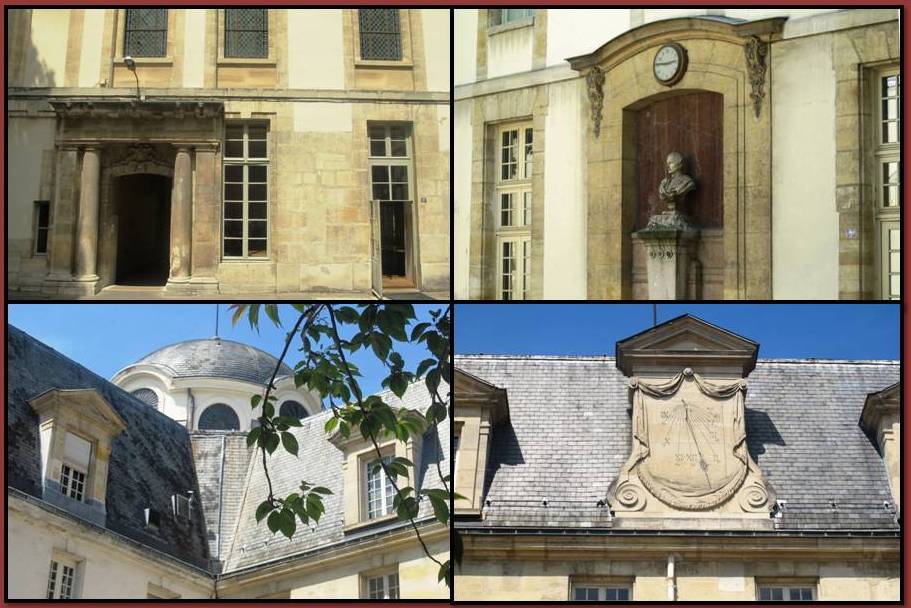
A few more
photos from the different interior courts.
In one of
the cloister aisles you can find what used to be the convent refectory, transformed
to a chapel during the 19th century, with a statue of Sainte
Genevieve, a relic from the destroyed abbey chapel.
What is
referred to as the “Salle des Actes”, used to be a chapel (“Chapelle de la
Miséricorde”). Recent excavations have permitted to find tombs of former
abbots, now covered by a wooden floor.
The “Salle
de médailles” (Room of the medals), used once to be a place where natural
curiosities were displayed. It’s today mostly used as a music room. The wooden
panels from the 18th century are in good shape, but the ceiling
obviously is in need of restoration.
To reach
these rooms, you will use these beautiful stairs.
There are
some other major stairs, “l’escalier des prophètes” also named “l’escalier de
la vierge” (the stairs of the virgin). The 17th century statue of the
virgin still wears some traces of the original paint, but it seems that some
student has added some lipstick colour.
These
stairs will lead to the abbot’s oratory…
… and
further up – now via some modern, added, stairs – to what used to be the abbey’s
library, which some centuries ago had one of the largest European book
collections, now transferred to the nearby Bibliothéque Sainte-Geneviéve (see
previous post). With a central cupola and four aisles forming a cross, after having
for some time served as dormitory, it’s today again used as library and working
space for the students. The floor has been restored according to original design;
the 18th century wooden walls are in good shape…, but the cupola and
what surrounds it seem to be in a very sad shape (see also top picture).
Through one
of the windows you can see the top of the “ClovisTower”.
The library
was during the abbey times open to public, but by using a separate entrance.
These were the stairs then to be used…
… leading
to this wooden door.
The inside
of the door has still some “fleur-de-lis”, associated with the French monarchy.
The question is still open how they escaped from the revolutionary inspections.
One detail
which draw my attention was this clock mechanism, with the inscriptions “…donated
by the Duc d’Orléans in 1743” and especially the phrase, made in Paris by “son
très humble et très obéisant serviteur Gallonde”. (Louis
Charles Gallonde obviously made a lot of clocks and astronomical instruments
during the 18th century.)
A lot of
nice things to be seen, but a lot of restoration work would be appreciated.




 Posts
Posts




