12.6.17

Ground Control


Last year I reported on a site named the “Grand Train” (see here). Temporary bars, restaurants, playground… were offered in a former railroad depot in the 18th arrondissement. This kind of activity continues one year after the other, but the spot changes. The basic idea is to, in cooperation with the National Railway Company (SNCF) and in a temporary way, use space before demolition and new building projects.


Opened only during the summer months, this summer (and next summer) the place chosen under the work name “Ground Control” is close to the Gare de Lyon, in the 12th arrondissement. “Halle Charolais” is a former warehouse and mail sorting centre. In two years a new housing project will get started. In the meantime, you can enjoy a different atmosphere, buy a book, get things to eat and drink with an emphasis on organic, ecological products… or just sit down and relax. 


8.6.17

Michelangelo on the top floor.


Referring to my latest post - In front of the shops, workshops, galleries… on Avenue Daumesnil, there is a rather surprising building, in an art deco style, but built as late as 1991. It holds a police station on the bottom floors and normal living quarters on the upper floors. The surprising thing is to find the top floor decorated by 12 giant reproductions of a Michelangelo statue, the Dying Slave.

Michelangelo (1475-1564) made two slave sculptures, the Dying one and the Rebellious one, around 1513. They were supposed to be part of the tomb that Pope Julius II ordered for himself. However, the tomb never became what it was supposed to be (a long story). Finally, the tomb was erected in 1545 in the San Pietro Vincoli church in Rome, but the only real Michelangelo part of the tomb is the famous Moses, also from 1513. Michelangelo offered the Slaves in 1546 to his friend Roberto Strozzi (Medici family), who later offered them to the French King François I. They changed owners several times (one of them was Richelieu), but became part of the Louvre Museum collection already in 1794, very soon after the Revolution. 
The architect of the building on Avenue Daumesnil is Manuel Núñez Yanowsky (with Miriam Teitelbaum). Still active, he has achieved some remarkable buildings, including these ones (“stolen” from the net) to be found in the Paris region. Here you can also see his project for the recently built Orthodox Cathedral in Paris, the real architectural winner, but finally not chosen (a long story). 
  

5.6.17

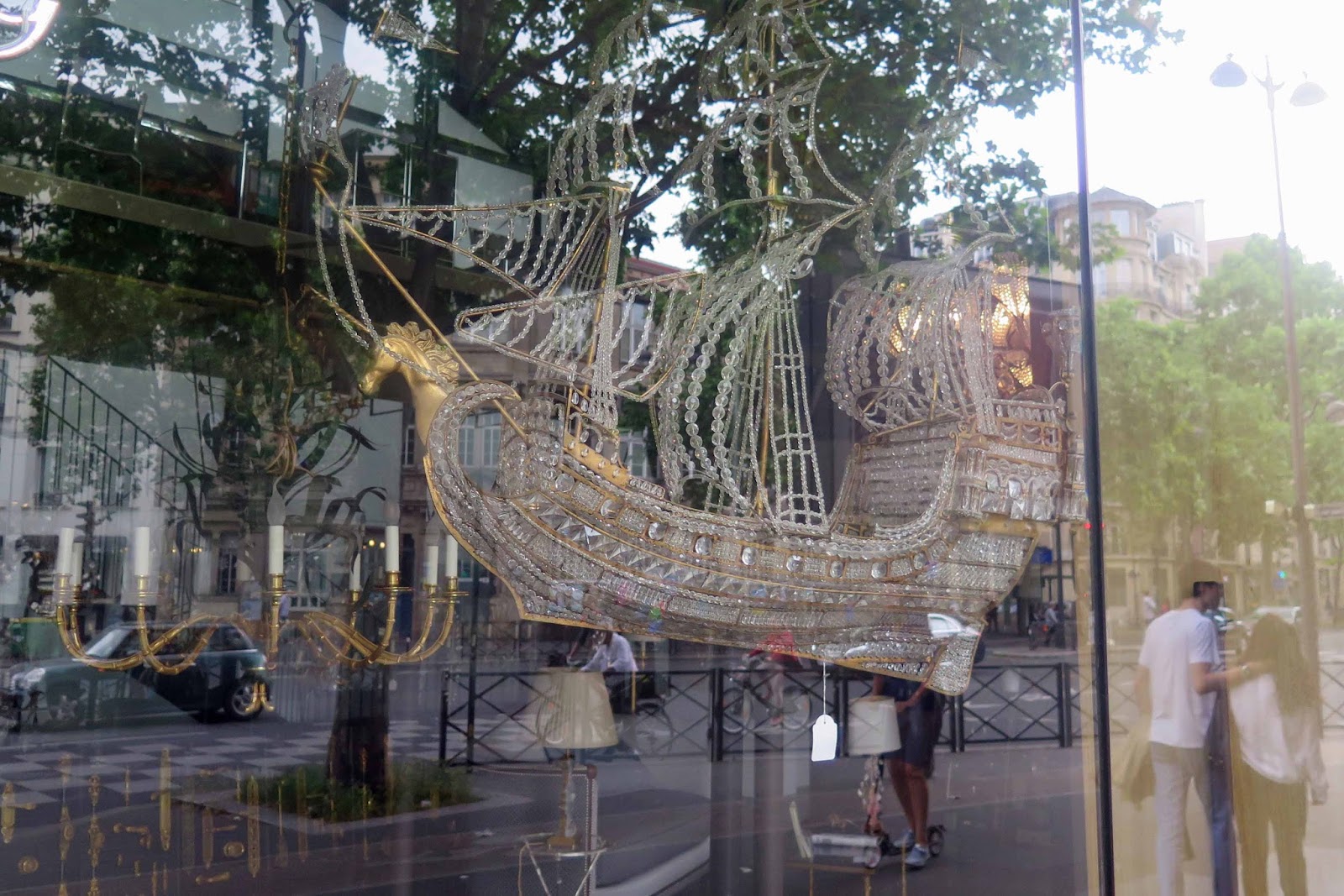
Window reflections…


I wanted to illustrate what, since the end of the last century, you can find under the vaults of what used to be a railway viaduct, the “Viaduc de Bastille”. The railway line, which closed in 1969, had its end station at the Bastille, where now the new opera house stands. The rail tracks on top of the vaults have been replaced by the “Coulée Verte” (Green Course). You can today make a 4.7 km (2.9 miles) walk all the way from the Bastille to the Bois de Vincennes. I wrote about the walk already ten years ago (see here).


The 64 vaults along Avenue de Daumesnil in the 12th arrondissement have now all got windows – thus the reflections – and behind the windows you can find shops, galleries, workshops, cafés… It all goes under the name “Viaduc des Arts”.

I feel that the top picture shows a bit of the atmosphere around the place – a piece of art behind the window and – as reflections – a loving couple, three bikers, a young lady on a kick-skateboard…

So, here you can - behind the reflecting windows – find not only shops, but also a large number of workshops – paintings and restored art objects, hand-decorated porcelain, creative jewelry, wedding dresses, embroidery work, umbrellas and parasols, handmade shoes, lithographs, restored and newly made violins… and also what today remains of the famous Pleyel piano maker. 


22.5.17

Music and poetry...

Sorry for having been a lousy blogger for a while… and probably will be so still for another while. I’m quite busy with a number of things right now. One of them has been the involvement in a chamber concert which took place last week.

It all started with an article about me in the Göteborgs-Posten, my birth town’s local newspaper. The article was read by a leading violinist in the Gothenburg Symphony Orchestra, more or less on her way to Paris. Her name is Marja Inkinen-Engström. She read about Paris walks, my interest in music… She contacted me… and we met. I arranged a meeting with a local friend and professional pianist, Cecilia Löfstrand, and we met in the 17th century apartment of another friend, author and poet, Birgitta Lindqvist. Spontaneously, it was decided to, as soon as possible, use the place - and the piano - for a chamber concert.

A couple of weeks later, in May, two weekend concerts could take place. Marja took a few days off, came to Paris again, and was joined by her friend Per Nyström who also flew in from Sweden with his cello. So, Marja, Cecilia and Per could perform together, concentrating on French rather contemporary chamber music. We had invited some selected guests, mostly members of the local Swedish Art Association, who could during the music pause listen to some wonderful poetry by Birgitta… and drink a glass of champagne.

Sincere thanks to everybody who made these memorable moments possible – the musicians and Birgitta – not forgetting the journalist who wrote the article which started it all, Johan Tollgerdt!


Unfortunately there is no video from the concert – you have to imagine! It was a moment never to forget!    

6.5.17

There will be a break...

I’m back from Sweden. I have a very busy program the coming few weeks, so there will hardly be any regular posting for a while. Also, I have already reported quite a lot on my birth town Gothenburg, so from this latest trip there will only be this duck mother and her 15 (!!!) babies, met in a street. I already published a photo on Facebook a couple of days ago. I should have made a video! The mother decided to leave the street for a little garden. There was a little wall. It took a couple of minutes before the last baby managed the jump – after many tries. Only then the mother decided to continue further into the garden. Can ducks count? 

Well, another little thing... I noticed that the French language sometimes is in use in Sweden.