12.7.14

Vincennes Zoo


Paris has been without a real zoo for a couple of years. The Vincennes Zoo opened again in April after years of renovation. I made a tour with my grandkids.

I know that there are different opinions on the good of keeping animals in zoos. What I can say after this visit is that the installations are really nice.

However, all animals are not yet there, but many are. Some were lazy or shy and didn’t wish to have their portraits and another excuse was that the weather was not the best. Mister Lion was more or less hiding…. 


Anyhow, here are some samples.


10.7.14

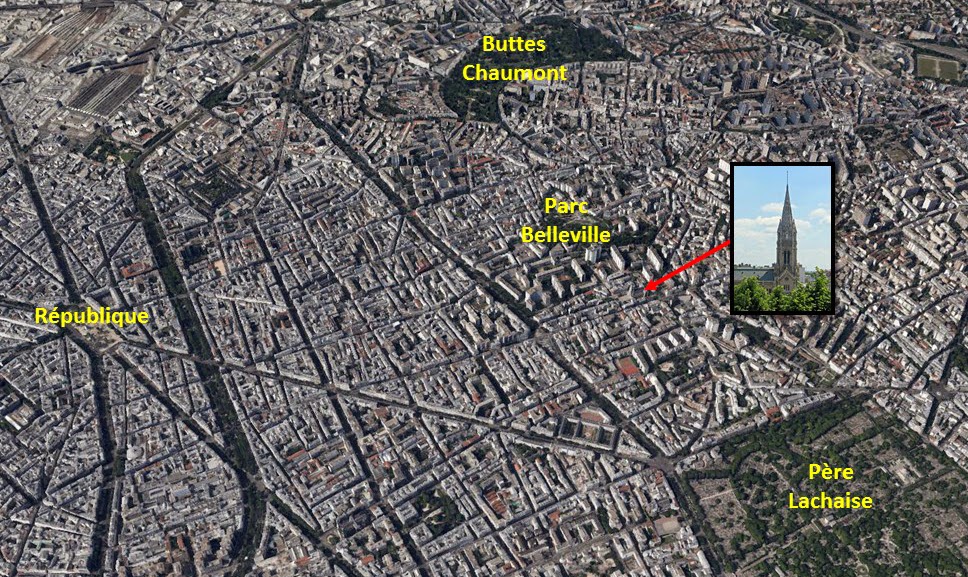
Notre-Dame-de-la-Croix ... de Menilmontant

There are some 270 churches in Paris intra-muros, whereof some 160 catholic, some 40 protestant, some 25 synagogues and some 20 mosques... Here is another Roman Catholic one, actually one of Paris’ biggest, but not among the most visited – Notre-Dame-de-la-Croix, to which you could add “de Menilmontant”, a quarter in the east of Paris on which I already have posted a few times (e.g. here and here). Menilmontant was a hamlet, part of the commune Belleville, which together with other suburbs was absorbed into Paris in 1860, then dominated by a working-class population. 
   
Menilmontant seeing its population grow considerably as from the beginning of the 19th century, there was a need for a church. A chapel was built, soon too small and replaced by the present church, built during the years 1863-1880. The works were of course again interrupted by wars and the Paris Commune in 1871 – meetings by the communards were held in the not yet completed church… .


The design is quite typical for churches built in Paris during these years, you may refer to it as neo-roman with gothic elements, especially in the interior.  What especially distinguishes it is the modern concept to use metallic visible girders. A specail word also for the organ, by the master organ builder, Arisitide Cavaillé-Coll, from 1874....

… and also, as built on a steep slope, about the imposing stairs in front of it.

Some photos of the interior, with a large number of paintings, sculptures…  


When you reach the bottom of the stairs in front of the church, you will find a nice little square, named after Maurice Chevalier, who was born and started his career in the small bars at Menilmontant.


In January 1916, Menilmontant suffered from bobming by a Zeppelin. Many injured and more than 20 killed. The official mass for the victims took place here.

Once there, you may notice in the little garden surrounding the church, a little building, decorated by kids – tiles with pictures and texts referring to “Europe”. 


7.7.14

Music, rain, flowers...


I went for a concert at the Bagatelle Park last Sunday. Rain, but the concert was indoors, in the “Orangerie”, the palm house, empty of orange trees and palms during the summer months. There is a “Chopin Festival” ongoing until July 14.  (You can book on “Classicagenda” in the sidebar.)

The roses are at least as beautiful with some rain drops. (See more about this park here, here and here.)


Saturday I had a very nice experience following a tour of Montmartre with a soprano, Veronica Antonelli, performing at some surprising places, including the vineyard, the calvary behind the Saint Pierre church… places you normally don’t accede. Crowds passing by, surprised, admired. (You can book a tour via a link on my sidebar.) 

3.7.14

Hôtel Lauzun


I had the privilege to visit this “hotel pariculier” (private mansion, townhouse) with one of Paris’ best preserved (and restored) 17th century interiors. It’s today referred to as “Hôtel Lauzun” and is since 1928 owned by the City of Paris. The building is to be found on Ile Saint Louis, which was more or less uninhabited until the 17th century, but then got a number of similar townhouses built, mostly for the aristocracy, but also for some rich “bourgeois”, which was the case with this building. The first owner, by the name of Charles Gruyn, had made a fortune on supplying cereals to the armies, later imprisoned (mixed up in Nicolas Fouquet’s disfavour). It seems to be a bit unsure who was the architect – Louis Le Vau or Charles Chamois and most of the interior decorators and painters are also unknown. The year of completion seems anyhow to have been 1657. 

The building got the name for which it’s known today from a later occupant, the Duke of Lauzun (1632-1723), an adventurous personality, with some serious ups and downs with regard to royal favours (ten years in prison), finally more or less secretly married to the “greatest heiress in Europe”, known as “La Grande Mademoiselle”, cousin of Louis XIV.

The exterior toward the Seine quays offers a beautiful balcony, some dolphin decorated gutters, and a miss-spelled inscription of Lauzun’s name.


Some pictures from the interior yard.


The views from the windows show nice surroundings such as the Seine River, the Pont Marie (… not the Mary you may believe, but the family name of the person responsible for its construction, complete in 1635), the dome of the Saint Paul Church…


Some views from the main entrance stairs, ceilings…


… and some from the first floor.


The second floor offers a row of rooms…


… all covered by paintings, especially by gold, and all kinds of decoration – no “empty space” anywhere. 


During the 18th century the premises had a number of occupants, but the island was no longer so popular with the higher aristocracy. The Revolution arrived. In the beginning of the 19th century this hôtel belonged to the Marquis de Pimodan, who temporarily gave it his name. Many of the mansions on the island were split into apartments, workshops… This one was saved by a rich art collector, the Baron Pichon, who bought it in 1842 and gave it back its name “Hôtel Lauzun”. He rented rooms on the top floor to some illustrious members of the literary intelligentsia, like Charles Baudelaire and Théophile Gautier. We can see the less prestigious stairs leading to this top floor. Baudelaire started to write “Les Fleurs du Mal” here and this is also where Baudelaire, Gautier, de Nerval, Dumas, Delacroix… met to do some drug experiments, the “Club de Haschischins”.  


Today the City of Paris has installed “L’Institut d’Etudes Avancées” here. You may be able to get in by the help of a professional guide or historian.    
          

30.6.14

A fabulous evening and night


I guess you can imagine what’s hiding behind this golden "frame". Yes, we are once more back to Versailles (see previous posts, here, here and here).


There was again a special event a couple of evenings ago, a triple concert by Jordi Savall, “Les Concerts des Nations” and “La Capella Real de Catalunya”, devoted to music by Georg Friedrich Händel (1685-1759).

I was in a privileged group (had of course  paid for it), which first met for some champagne drinking in the “Vestibule”, overlooking the gardens and the open doors to the “Royal Chapel”. I had the pleasure to meet and talk to Jean-Pierre Marielle, a now 82 year old very popular actor, here photographed by his wife and actress Agathe Natanson. We talked for quite a while and I can confirm that he is as nice a person as you may imagine before you meet. I will revert to him further down as his name is quite linked to Jordi Savall.

It was then time to go to the “Royal Opera”. We were not allowed to take photos (or videos) during the concert, but here are at least some photos from the beautiful theatre. We got good seats and listened to “Water Music” and “Guilio Vesare in Egitto”.


Time for champagne again, before going to the “Royal Chapel” and listen to “Alexander’s Feast” and “Concerto Grosso in Re major”.

Then a walk through the drawing-rooms “Hercules”, “Of Plenty”, “Venus”, “Diana”, “Mars”, “Mercury”, “Apollo”…

… before reaching the corner “War” drawing-room and enter the fabulous “Hall of Mirrors”.

Here we listened to “Il Parnasso in Festa”, followed by “Music for the Royal Fireworks”…


… and when the music reached the final “La Réjouissance” part, all the audience turned their heads to the right to watch the fireworks outside!

Let’s listen to the “Fireworks” as played at a previous Jordi Savall concert.
The final part, “La Réjouissance” is not played in this video - here it is played by another orchestra. So, this was the music which accompanied the real fireworks we saw.
     
Time for thanks and a standing ovation!

Then, it was time for the little extra surprise, Jordi Savall making a solo gamba performance on the balcony of Louis XIV’s bedchamber.

After all this, time to go back to the “Vestibule” for some more champagne, again overlooking the “Royal Chapel”, now in the dark,  and meet the musicians and singers. Jordi Savall was there and I could even exchange a few words with him … and he met Jean-Pierre Marielle, a surprise.


This brings us to the link between them both, the wonderful movie “Tous les Matins du Monde” (“All the mornings of the World”) by Alain Corneau, from 1991, which starred Gerard Depardieu and Jean-Pierre Marielle… and where the musical part, so important for this film, was done by Jordi Savall. Let’s watch Jean-Pierre Marielle - in the role of Monsieur de Sainte-Colombe (1640-1700) - pretending to play what Jordi Savall is playing for real!  


I would finally suggest that you listen to Jordi Savall and friends playing and improvising "Folias de España" by Marin Marais (1656-1728), role held by Gerard Depardieu in the movie.