10.10.16

Finally...


I have often wanted to get behind this gate…for many reasons. Finally…

One reason was to see the northern “mire”! It’s placed in the garden of what now is a private residence at Montmartre and which corresponds to the famous “Moulin de la Galette”. This “mire” has stood here since 1736 and is one of the two monuments you can find inside Paris to mark the French Meridian. The other one, the southern “mire” can be found in the Parc de Montsouris (see previous post).

I have already written about the French Meridian several times, e.g. after a visit to the Paris Observatory (see here). Maybe just a few words to remind you that the French Meridian (also sometimes referred to as the “Rose Line”) was defined in 1667 and later played an important role in the establishment of the metric system and the meter – introduced by the First French Republic in 1799 (and today adopted by all countries except Liberia, Myanmar… and the U.S.).  In 1884, there was an international conference to decide on one Meridian – there were tens of them - and the British Greenwich Meridian became the international reference. (When the French agreed to abandon their line, there was a compensation granted by the British - a promise to go for the metric system; it took some time.)  

In 1994 some 135 "Arago medallions" were placed along the line (many have been stolen since). François Arago (1786-1853) was a French astronomer (and much more) who - among many other things - helped determine the exactitude of the Meridian and the Meter. One of the medallions is placed in front of the “mire” and we can see that there has been a slight correction to the original line (see top picture).  


Let us also remember that between the two remaining buildings and the two wind mills, “Blute-fin” and “Radet”, the owning family Debray decided in 1870 to establish a “guinguette” (small restaurant with music and dancing) when milling by the force of wind was not profitable anymore – the “Moulin de la Galette” was opened to public and became extremely popular for some decades. 


Here we have again some illustrations by painters including one of the most famous Renoir ones and the first Paris painting sold by Picasso (see here). People could then walk around in the area and climb a platform of the “Blute-fin” mill, where later a dancing scene in “An American in Paris” with Gene Kelly and Leslie Caron takes place (obviously shot in studio).  


6.10.16

Parc de Bagatelle - again and again.


This is the fifth time I talk about the “Parc de Bagatelle” in the outskirts of the “Bois de Boulogne”, so I’m not going to once more refer to the history of the place. (See previous posts here, here, here and here.) The park may be particularly known for its rose garden, but when I went few days ago, the rose bushes were tired… or perhaps preparing a last blossoming. There is an annual “rose contest” - also this year’s winner was taking a rest… but there were of course some flowers on other bushes.


Just as a reminder, here is a photo from a previous post with some more roses.


The gardeners were quite busy.

Some other views of the little castle, which was built in two months after a bet between Marie-Antoinette and her husband’s brother, the future Charles X…

… the gardens…


… the peacocks (they are all over)…


… and some other birds. They all walk (swim and fly) around freely in the park.


One special mention for this tree, planted here in 1907 (the park had become public in 1905),  which I wanted to photograph on behalf of a Chilean who is preparing a book about this very special species with origins on the Chilean Andes slopes, but today under threat of disappearing there. It is the “national tree” of Chile. Its Latin name is “Aracuaria aracuana”. It was later planted in Europe with better success. There are no monkeys in the Chilean Andes, but because of its very hard trunk, lack of lower branches and sharp-edged leaves it became in Europe referred to as the “Monkey Puzzle” (“Désespoir des Singes”…). I once photographed (see here) another little Paris “Aracuaria aracuana”, planted 100 years later – in 2007 in presence of the Paris Mayor and a former Chilean Minister – and to be found in a little square, split in two, with the names “Santiago-di-Chile” and “Salvador Allende”. 
                            

3.10.16

Giverny - again


I already posted about Monet's Giverny some six years ago (see here), but I had the privilege to return with my friend Christina Björk, who together with the illustrator Lena Andersson wrote a bestseller about the little girl Linnea who visited Paris and Giverny, accompanied by a friend of her family. The book “Linnea in Monet’s Garden” has been sold worldwide in millions of copies, has been filmed… . Here we can see Christina surrounded by sculptor friend Barbro Hedström and journalist and author friend Gunilla Boëthius.

Thanks to Christina we were received as VIPs!

So, again some pictures from Monet’s home, outside and inside…


… from the flower garden in front of the house, the “Clos Normand”…


… and from the water garden with its Japanese bridge, the nympheas (unfortunately hardly in bloom late September)…


Monet later added a larger studio (needed for his giant nymphea paintings), which now is the souvenir shop. Here we of course found Christina’s book for sale.


There is more to see in the charming little village and you can end up by visiting Monet’s family grave at the local cemetery.  


29.9.16

What a small street can hide...


Walking along a small discrete street in the 15th arrondissement, rue Blomet, you can find a little green space, where you can play “pétanque” – if you are a member of the “Union Bouliste du 15e”. “Pétanque” is of course one form of the game of “boules” where you are supposed to toss or roll steel balls as close as possible to a small wooden ball, in general red, referred to as the “cochonnet” (actually meaning "piglet"). “Pétanque” comes from the provençal dialect word “petanca” which refers to “feet fixed” – on the ground. “Pétanque” should be played with the feet fixed. There are other forms of the “boules” games where you e.g. can do a “run up” to the throw, in France in general referred to as “boule lyonnaise”.

The game, mostly played by amateurs as a nice relaxed pastime, needs however - as we can see - a lot of concentration. (There are some more or less professional players also – not here – and even World Championships.)

Then comes the time for measuring the distance to the “cochonnet”.

There is also time for a break.

Immediate neighbour to the “pétanque” ground, 45, rue Blomet, there is now a little square - previous buildings are gone. This used once to be the home of the French sculptor Alfred Boucher (1850-1934), who had Camille Claudel as a pupil, working as a teacher at the “Académie Colarossi” (I posted about it here.). He even sculpted Camille reading a book. When Boucher moved to Florence he asked his friend Auguste Rodin to take over… and we know what then happened. 

During the 1920’s Juan Miro (1893-1983) shared a studio here with his friend Pablo Gargallo (1881-1934).

Robert Desnos (1900-1945), a poet who played a key role in the Surrealist movement also lived here. His home became a meeting place for the leading Surrealist artists like Arp, Dubuffet, Ernst, Gris, Malakine, Picasso, Man Ray, Tanguy, including authors, poets like Eluard, Hemingway, Leiris, Gertude Stein…

Miro later offered the sculpture “L’oiseau lunaire” (The Moonbird) which was placed here in 1974. It’s meant as an homage to the poet Robert Desnos (also an active resistant who died in a concentration camp).


A close neighbour to 45, rue Blomet, was the cabaret “Bal Nègre” (at no. 33). (No picture here – the building is behind scaffolding.) Before closing in the 1960’s and especially during the 1920-30’s, this was a place where the above mentioned artists met, but also Joséphine Baker, Maurice Chevalier, Mistinguette, Foujita, Kiki de Montparnasse, Alexander Calder, Henry Miller, Ernest Hemingway, F.S.Fitzgerald, Jean Cocteau, Francis Picabia, Kees van Dongen… and even the future King Edward VIII. Later Sydney Bechet played here and the future Saint-Germain-des-Prés “gang” – Sartre, de Beauvoir, Vian, Prévert, Gréco… - met. The place is supposed to reopen in 2017, the scaffolding will hopefully be gone and I may go there.
  

26.9.16

Stockholm (2) - the archipelago.


There is a “must” to include in a visit to Stockholm – the archipelago with its some 30.000 islands, islets and rocks, a few smaller towns and villages and some 50.000 holiday cottages.

It could perhaps be mentioned that the archipelago (and the surrounding area) is named “Roslagen”. During the “Viking times”, Swedes coming from this area went east. Some of them, the people of “Ros”, settled there, were then referred to as the “Rus people”, which finally led to the name of the state of Russia – you can read about it, more in detail, here.

A number of ferries and boats of all kinds offer communication between Stockholm and the islands.

In Sweden you can enjoy the “Allemansrätt” (everyman’s right) - everybody should have right to nature. This also gives the right to go ashore or anchor anywhere which is not in the direct vicinity of private buildings - perfect for boating, further helped by the fact that there is no tide.

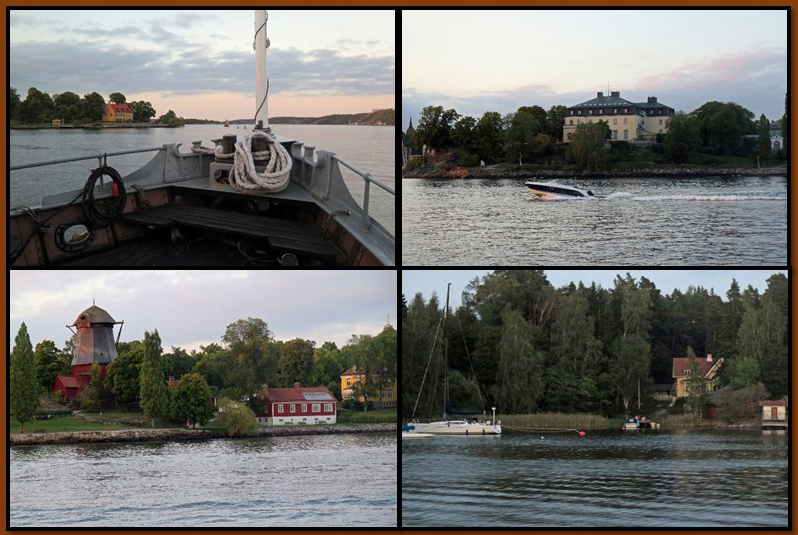
There are still some old steamers around. To finish my Stockholm visit, with some friends, I took an evening tour on one of them. It found its way among the islands from Stockholm to Vaxholm – and back.

Here are some views of the “Blidösund”, built in 1910, and of what you can watch from the inside or from the deck – the September weather was exceptionally kind.


When it got dark we went inside for an excellent dinner.


A last glimpse of the full moon and, earlier in the evening, something (what?) moving in the sky.